
25 February 2026 | Kamyar Dobakhti, University of Ljubljana, Slovenia | Blog
Hey everyone, my name is Kamyar a PhD student at University of Ljubljana in the Heat4Energy project, I work on the development of a 10 W to 100 W device for harvesting the heat between 40 °C and 100 °C. I will explain what my work is all about, but first let’s continue from the previous blog post and focus on the devices to see why we need new types of energy harvesters.
In 2018, it was estimated that the waste heat in temperatures lower than 100 °C, account for 733.5 PJ per year only within the European Union [1]. This number is huge, and in order to show this let me give you a real-world example. On average a two-person household uses ≈ 3,500 kWh of electricity per year [2] and this amount includes an electric water heater. With a simple calculation we can see that this wasted energy can power 58 million households. Or gasoline has an energy content of ≈ 34 MJ/l, so this energy is equal to burning 21 billion liters of gasoline.
The recovery of low-grade energy is particularly challenging due to its low density, dispersed nature and intrinsic limitations, for this reason, there are not many technologies capable of this task. Organic Rankine Cycle systems allow us to recover waste heat from temperatures above 100 °C [3-4], but for lower temperatures, currently, the main-stream solution is thermo-electric modules based on the Seebeck effect [5], these systems generally require a relatively large temperature difference to provide a reasonable power output, and they have a low energy conversion efficiency, which limits their applications for energy harvesting [6-7].
In contrast to these technologies, thermomagnetic generators are considered a promising technology as the second law efficiency can be theoretically higher than any market available technology, they can be made without moving parts, and scaling down is not yet possible for the organic Rankine cycle systems (ORC). Furthermore, ORC systems suffer from low exergy efficiency in small-scale devices [4].
Now let’s introduce different working principles of thermomagnetic energy harvesters
Thermomagnetic energy harvesters typically have two primary designs, one of which focuses on converting exergy into mechanical motion. Such devices are called thermomagnetic motors or Curie wheels. The first patent for such devices was made by Edison in 1888 [8]. This rotary movement can be converted to electrical energy by conventional generators, or the movement can be used directly for another application [9]. In addition, linear thermomagnetic motors and oscillatory devices should be mentioned; in these devices, the exergy is converted to linear or oscillatory movement, and these movements can also be coupled with other technologies (for example piezoelectric).
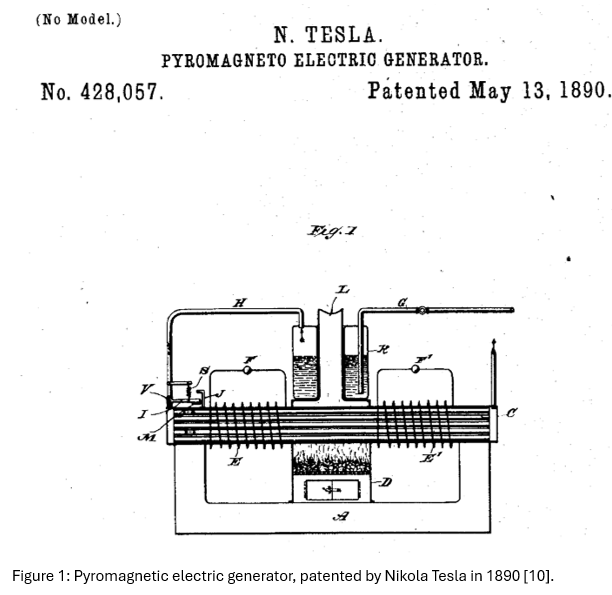
In the second category, thermomagnetic generators eliminate the need for any mechanical displacement of the thermomagnetic material and in this implementation of a thermomagnetic cycle, the working material is used as a thermally activated magnetic flux switch, which is created by a permanent magnet. The first patent for such a device was filed by Tesla in 1890 in the name of Pyromagnetic electric generator [10]. The patent is visible in Figure 1.

Challenges and fixes
The idea of thermomagnetic power generation was first revisited in 1948. Since then, there have been numerous works on the topic and notable progress has been made in device design and performance. However, key challenges remain, including a low second law efficiency and low power density, largely due to limited operating frequency, hydraulic losses, and fluid mixing. Additionally, scaling up continues to prove challenging. Given these limitations, I can now introduce my position in the Heat4Energy project 🙂 .
My research aims to explore technical solutions to key challenges in current thermomagnetic generator design, by introducing a high-frequency regenerator, which is configured in parallel instead of the traditional series placement. This approach seeks to overcome limitations such as low efficiency, low operating frequency, hydraulic losses, fluid mixing, and difficulties in scaling up. The primary objective is to investigate a novel design for a low-temperature, high-frequency regenerative thermomagnetic generator.
Now, you may question what my work is all about after all these explanations, to simplify:
- developing a numerical model,
- optimization of the design using this model,
- and building the demonstration device to reach the Technology Readiness Level (TRL) 6
are parts of my work.
Conclusion
Ultimately, harvesting part of this waste energy is vital for the future of our planet. While thermomagnetic devices represent one of the most promising solutions, they, like any emerging technology, currently face numerous limitations. At the Heat4Energy project, our mission is to overcome these technical hurdles and accelerate the transition toward a greener future.
If you are interested in our research and want to see how we are paving the way for the next generation of energy, please follow our updates in this Blog, YouTube and LinkedIn.
Attribution: Originally published by HEAT4ENERGY. Reposted with permission. Original article: https://heat4energy.eu/blog/blog-6-static-thermomagnetic-energy-harvesting-why-we-need-them-the-struggles-and-fixes


