
01 June 2026 | SAVVINA MARIA PAPAIOANNOU, BAM, BERLIN | Blog
Introduction
Advanced thermomagnetic energy conversion requires processes that can produce very fine structures with sufficient precision and reproducibility. This is particularly challenging, as thermomagnetic materials are often brittle and difficult to shape without introducing defects. Recent progress in processing has made it possible to fabricate thermomagnetic heat exchangers with complex geometries and high resolution, enabling their use in a new energy‑harvesting application.
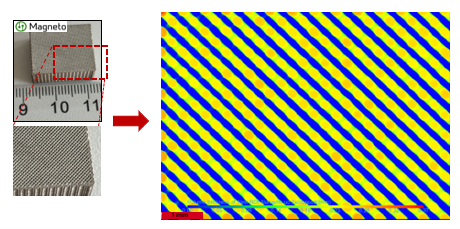
To evaluate whether these structures are manufactured as intended without destroying them, I use X‑ray computed tomography (XCT), which enables a non-destructive, three-dimensional measurement of the entire thermomagnetic heat exchanger block, as shown in the image below.

Figure 1: 3D-printed block (provided by industrial partner Magneto B.V.) and filament diameter measured across the entire structure. Different colours indicate a different filament diameter.
Within the Heat4Energy project, a technology is being developed to convert low-grade waste heat produced by industrial processes into electricity through a generator based on Faraday’s law of induction and thermomagnetic materials. Parts of the generator setup consist of thermomagnetic 3D-printed heat exchanger components. The 3D extrusion and post-heat treatment processes of these fine parts may introduce various defects that have an impact on their heat transfer efficiency, magnetic and mechanical properties.
My Role: From Defects to Reliability
My main contribution to the project is to identify the structural defects that lead to failure in thermomagnetic 3D-printed heat exchanger blocks, and to select materials and designs that will withstand the conditions in the demonstrator devices for a large number of operating cycles. This means that I am not only studying how these materials perform, but I am also focused on how they fail, and why. Understanding the mechanisms that lead to material failure enables the design of more reliable energy harvesting systems.
But how can we design materials that don’t just work—but keep working over time?
The Science behind my work
Seeing inside the material without slicing it
One of the most powerful tools I use is X-ray computed tomography (XCT), a non-destructive characterization technique that uses X-ray radiation to look inside the material in 3D without slicing or damaging it.
The principle behind this is similar to a medical CT scan, but applied to engineered materials.
After obtaining the 3D data from XCT measurements, Dragonfly, an image-processing software, is used to design the image analysis route.
Image analysis results determine:
- The geometry of the filaments and the channels of the heat exchanger blocks
- The void fraction (porosity)
- The surface area available for heat transfer
- Hidden defects, such as blocked channels, overlapping filaments, and internal porosity gradients.
This capability is crucial because many of these defects are invisible from the outside, but they have a strong impact on the material’s performance.
From structure to failure: Mechanical Testing
However, exploring the material from the inside is one part of the story. The 3D data allows us to move through the entire volume of the sample slice by slice. To understand how the material fails, we also perform mechanical testing, such as compression tests.
These tests allow us to:
- Measure how strong the structure is
- Identify when and where failure occurs
- Understand how the structure deforms under load
In-situ XCT is another key technique, where we scan the material, while it is being compressed. This allows us to observe where cracks initiate, how they propagate through the structure, and which defects trigger failure.
By combining all these techniques, we can directly link: Microstructure → Defects → Failure mechanisms
Real-world Impact
Low-grade waste heat is all around us, from everyday activities to large-scale industrial processes. At the same time, there are very few technologies available to efficiently convert low-temperature waste heat into electricity.
By developing and commercializing reliable thermomagnetic heat exchangers, we pave the way to connect industrial processes and everyday systems with sustainability, the circular economy, and energy upcycling.
Conclusion
By combining non-destructive characterization techniques like XCT with mechanical testing, I aim to study the hidden mechanisms that influence reliability in thermomagnetic materials. Understanding failure is not a limitation, but a path to better material and product design. By designing more reliable materials, we are one step closer to turning waste heat into a sustainable source of clean energy.
References:
- Funk, Alexander, et al. “MnFePSi-based magnetocaloric packed bed regenerators: Structural details probed by X-ray tomography.” Chemical Engineering Science 175 (2018): 84-90.
- Du Plessis, Anton, et al. “Standard method for microCT-based additive manufacturing quality control 1: Porosity analysis.” MethodsX 5 (2018): 1102-1110.
- You, Xinmin, et al. “Magnetic Phase Diagram of the Mn x Fe2− x P1− y Si y System.” Entropy 24.1 (2021): 2.
Attribution: Originally published by HEAT4ENERGY. Reposted with permission. Original article: https://heat4energy.eu/blog/blog-11-how-xct-and-image-analysis-support-high-performance-thermomagnetic-heat-exchangers


