

Cooling is often discussed in the context of buildings, comfort or food storage. But in vaccine logistics, refrigeration becomes a public health issue.
A vaccine is only useful if it remains effective until the moment it is administered. That depends on a cold chain capable of maintaining the right temperature through manufacturing, storage, transport and last-mile delivery. When that chain fails, the consequences are not only technical or financial. They can affect access to life-saving medicine.
According to the MAGCCINE project website, 1.5 million lives are lost globally due to limited access to vaccinations. At the same time, more than 50% of produced vaccines are wasted, primarily because of ineffective temperature control during storage and transportation. [1]

Vaccines being transported through remote regions, where maintaining a reliable cold chain is critical to preserving vaccine effectiveness and reducing waste.
Source: UNICEF/UN0826264/Vallejo Prut, https://www.unicef.org/supply/vaccine-carriers
These figures show why vaccine cold chains are such an important test case for clean cooling. The challenge is not only to reduce environmental impact. It is to build refrigeration systems that are safe, efficient and reliable enough for critical healthcare infrastructure.
The cold chain challenge behind global vaccination
Most vaccines need to be kept within a controlled temperature range, commonly between 2°C and 8°C. Maintaining this range may sound straightforward, but vaccine transport is a demanding refrigeration application. [1,2]
Vaccines may pass through warehouses, aircraft, vehicles, clinics and remote delivery points before reaching patients. Along the way, cooling systems must protect temperature stability across changing ambient conditions, transport routes and handling environments.
In regions with unstable electricity supply, limited maintenance capacity or long last-mile delivery routes, these requirements become even harder to meet. A system that performs well in a controlled facility may not be equally suitable for transport conditions where power, space, weight and safety are all constraints.[2]
This is why the vaccine cold chain is more than a refrigeration problem. It is a resilience problem.
Why conventional refrigeration faces pressure
Today’s vaccine cold chain still relies heavily on conventional refrigeration technologies. These systems are mature and widely used, but they face several challenges in medical transport.
One challenge is refrigerant safety and regulation. The MAGCCINE project highlights increasingly strict regulations on aerial transport due to the hazards associated with refrigerant gases. For vaccine distribution, where air freight can be essential, this can complicate logistics.[1,4]
A second challenge is energy demand. High energy consumption becomes especially important in remote or off-grid settings, where cooling reliability may depend on limited power availability. In these contexts, energy efficiency is not only a sustainability benefit. It directly affects the ability to keep vaccines within the required temperature range. [2]
A third challenge is climate impact. Some conventional refrigerants have high global warming potential, adding environmental pressure to a sector where demand for cold-chain capacity continues to grow. [1,2]
Together, these challenges point toward a broader need: new cooling technologies that can reduce environmental impact without compromising safety, efficiency or reliability.
MAGCCINE: applying magnetocaloric cooling to vaccine transport
MAGCCINE — Clean and Efficient Cooling in Vaccine Transportation Using Rotating Magnetocaloric Effect — is a EIC Pathfinder Challenge project developing a clean, efficient, solid-state magnetic refrigeration system for vaccine transport. [1,2]
The project runs from 1 October 2024 to 30 September 2028 and is coordinated by the University of Porto. Its consortium includes CNRS, University of Sevilla, University of Aveiro, MagREEsource, Helium3 Technologies and University of Ljubljana.
Rather than treating magnetocaloric cooling as a general laboratory concept, MAGCCINE focuses on a specific and demanding use case: vaccine refrigeration in the 2–8°C range. This gives the technology a clear application target, where temperature stability, safety, energy efficiency and transport suitability all matter.
The project’s goal is to design and optimise a fully operational vaccine refrigeration prototype. If successful, it could represent an important step in moving magnetocaloric cooling closer to practical cold-chain applications.
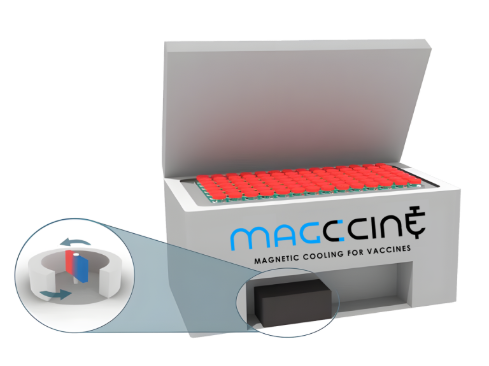
Concept rendering of the MAGCCINE vaccine cooler, which uses the rotating magnetocaloric effect (RMCE) to provide refrigerant-free cooling for vaccine transport. Source: MAGCCINE.
Why the rotating magnetocaloric effect matters
Magnetocaloric cooling uses the thermal response of magnetic materials under changing magnetic conditions. MAGCCINE focuses on a specific route known as the rotating magnetocaloric effect, or RMCE.[2]
According to MAGCCINE project information, this RMCE-based approach was patented in 2023 by project partners. The project describes the technology as
- Reducing the need for permanent magnets
- Significantly lowering production costs
- Reducing volume and weight
- Enhancing efficiency [1,4]
This is important because magnet use is one of the key engineering considerations in magnetocaloric systems. Reducing the need for permanent magnets can help address several practical barriers at once: cost, compactness, system weight and manufacturability.
RMCE also supports the wider value proposition of solid-state magnetic refrigeration. The system is being developed as a form of solid-state magnetic refrigeration based on magnetocaloric materials, eliminating the need for harmful refrigerant gases. For vaccine transport, that matters for both environmental and safety reasons. [1,2]
At the same time, the significance of MAGCCINE should be framed carefully. The project does not mean magnetocaloric cooling is ready to replace all conventional refrigeration. Instead, it shows that the technology is being explored in a focused, high-value application where its advantages could be especially relevant.
From vaccine cold chains to clean cooling infrastructure
MAGCCINE matters because it connects clean cooling with a real-world, high-demand use case. In many discussions, sustainable refrigeration is framed mainly around replacing high-GWP refrigerants. That remains important. But the next generation of clean cooling will likely require more than refrigerant substitution. It will also depend on system efficiency, reliability, safety, compact design and application-specific engineering. [2]
Vaccine cold chains bring all of these questions together. They require low environmental impact, but they also demand stable temperature control and dependable performance across complex logistics networks. A clean technology that cannot maintain the required temperature is not enough. A reliable technology with high climate impact is also not enough.
This is why MAGCCINE is a useful ecosystem example for the magnetocaloric cooling sector. It shows how solid-state, refrigerant-free cooling is being directed toward applications where performance requirements are strict and the societal value is clear.
The project is still in development, and further work will be needed before RMCE-based refrigeration can be evaluated for broader deployment. Prototype validation, reliability testing, material scale-up and economic feasibility will all be important.
Even so, MAGCCINE reflects growing momentum around magnetocaloric cooling as part of the clean cooling transition. It moves the conversation from general technology promise toward a concrete question: can solid-state magnetic refrigeration support safer, cleaner and more efficient vaccine transport?
Clean cooling is not only about lowering emissions. It is about strengthening the infrastructure that protects people, medicines and resources. Vaccine cold chains make that clear — and MAGCCINE offers a timely example of how magnetocaloric cooling could contribute to that transition.
References
[1] MAGCCINE. Clean and Efficient Cooling in Vaccine Transportation Using Rotating Magnetocaloric Effect. Available at: https://magccine.eu/
[2] European Commission, CORDIS. Clean and efficient cooling in vaccine transportation using Rotating Magnetocaloric Effect — MAGCCINE, Project ID 101161135. Available at: https://cordis.europa.eu/project/id/101161135
[3] Laboratory for Refrigeration and District Energy, University of Ljubljana. MAGCCINE. Available at: https://lahde.fs.uni-lj.si/en/magccine/
[4] University of Aveiro, CICECO. Clean and efficient cooling in vaccine transportation using Rotating Magnetocaloric Effect. Available at: https://www.ciceco.ua.pt/?language=eng&menu=208&projectid=2047&tabela=projectosdetail


