06 May 2026 | Sergiu Lionte, Magnoric | Blog
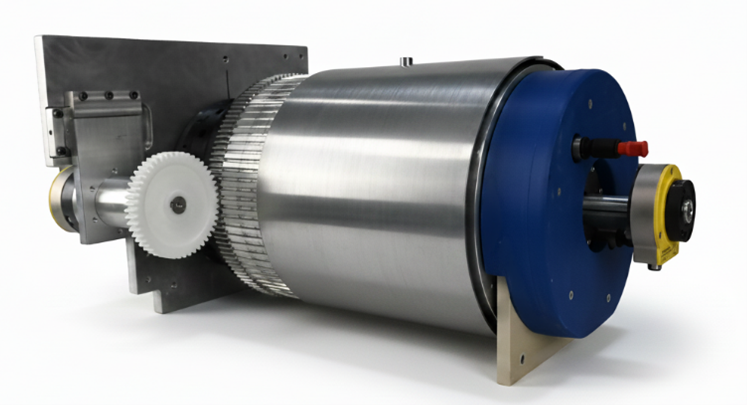
Our solid-state solution of thermomagnetic energy conversion is based on a Thermomagnetic Motor (TMM) that exploit the magnetocaloric effect: a solid-state unit that allows direct conversion of low-grade waste heat into mechanical motion and then into clean electricity.
The magnetocaloric effect implies that certain materials change their magnetic properties (from paramagnetic to ferromagnetic and reverse) with temperature. Near their Curie point, these materials exhibit sharp changes in magnetization when exposed to a magnetic field. By cycling them through a temperature gradient, such as between a hot source and a cold source, it is possible to generate continuous changes in the magnetic force and thus a magnetic torque.
In a TMM system this effect is used to produce motion. Our R Pilot system includes:
- A magnetic circuit with NdFeB permanent magnets
- Specific magnetocaloric materials designed to cover a given temperature range
- Our custom design which converts magnetic force variations into rotational motion
Unlike conventional heat engines, thermomagnetic systems do not rely on phase changes or combustion. As a result, they offer high reliability, low maintenance requirements, and silent operation, all important advantages in different environments.

Heat4Energy project : Magnoric’s commitment to disseminate the TMM technology
Magnoric’s role as industrial partner in the Heat4Energy project is to realize realistic prototype devices and promote public awareness for thermomagnetic devices through research and development.
Within this framework, Magnoric hosted a secondment from one of the academic partners, Helmholtz-Zentrum Dresden-Rossendorf (HZDR), Germany. Between March and the end of April 2025, Ali, a doctoral candidate involved in the project, joined our team for a one-month exchange. His work focused on finite element simulations of thermomagnetic motors (TMM), contributing to improved modeling of magnetic and thermal interactions—an important step toward better device performance and future design optimization.

Thermomagnetic Motors applied to maritime industry: hybrid maritime vessels
A potential application of our TMM technology is the maritime industry, especially in the case of hybrid maritime vessels. The maritime sector is going through a major transition, driven by the need to cut emissions without compromising performance. Hybrid propulsion systems are increasingly seen as a practical pathway between conventional engines and fully electric solutions. However, even the most advanced vessels still lose a large share of onboard energy as low-grade waste heat, typically below 150 °C. At Magnoric, we don’t see this as a loss, but as an opportunity.
Magnoric has also been actively engaging with the maritime community to present and discuss this emerging technology. In this context, thermomagnetic waste heat recovery solutions have been previously presented at the Rostock Ship Machinery Conference in 2023, highlighting early efforts to bring magnetocaloric-based energy conversion concepts into maritime applications and initiating dialogue with industry stakeholders.
The unexploited potential of low-grade waste heat
Marine engines, whether diesel, LNG or hybrid-electric, generate significant amounts of heat during operation. While high-temperature heat is sometimes reused, low-grade heat is usually rejected through cooling systems. This wasted energy can represent up to 30 to 50% of the total fuel input.
In hybrid vessels, where efficiency is already a priority, recovering even a fraction of this heat can lead to meaningful improvements in overall performance. Conventional technologies like Organic Rankine Cycles (ORC), tend to be less effective at lower temperatures due to efficiency limits and system complexity. Our solution based on thermomagnetic energy conversion directly addresses this gap.
Thermomagnetic generators designed specifically for integration into hybrid vessels, operate efficiently within typical marine waste heat temperature ranges, such as:
- Engine cooling loops (70–120°C)
- Exhaust gas heat exchangers (after primary recovery)
- Auxiliary onboard thermal processes
By adjusting the Curie temperature of the magnetocaloric materials to these heat sources, we can maximize efficiency within realistic operating conditions.
Benefits for vessel operators
Thermomagnetic waste heat recovery brings several clear advantages:
- Fuel savings and efficiency gains: Recovering waste heat reduces the load on primary power generators.
- Reduced emissions: Each kilowatt-hour generated from waste heat directly lowers CO₂ and NOx emissions.
- Improved hybrid system performance: Additional onboard generation supports better load balancing and battery management.
- Low maintenance and high reliability: The absence of pressured fluids, turbines, and high-pressure components increases robustness.
- Silent and vibration-free operation: This contributes to quieter and more comfortable vessels.
Toward cleaner maritime energy systems
The maritime industry faces increasing pressure to reduce its environmental impact, while staying economically competitive. Hybrid propulsion is an important step, but unlocking its full potential requires a more comprehensive approach to energy use.
Through initiatives like Heat4Energy, thermomagnetic technology is moving closer to industrial reality. By bridging advanced materials research with real-world engineering constraints, the project is laying the groundwork for a new class of energy recovery systems, that can also be adapted to maritime applications.
In this context, propulsion systems become part of a broader energy ecosystem where even low-temperature heat can be put to productive use.
About Magnoric
Magnoric develops magnetocaloric units designed to refrigeration systems as well as thermomagnetic energy conversion systems that turn low-grade waste heat into electricity, enabling new efficiency gains across industries and supporting the transition to more sustainable energy systems.

About VULKAN Group
VULKAN Group, the main shareholder of Magnoric, is a long-established provider of marine propulsion and power transmission technologies. Founded in 1889 and based in Germany, the company is known for its expertise in flexible couplings, composite shafts and vibration control systems used across a wide range of vessels.
With decades of experience in drivetrain optimization and a strong focus on hybrid and electric propulsion systems, VULKAN brings valuable system-level knowledge of energy flows in maritime environments supporting the integration of new technologies such as thermomagnetic waste heat recovery.

Attribution: Originally published by HEAT4ENERGY. Reposted with permission. Original article: https://heat4energy.eu/blog/blog-10-turning-waste-heat-into-clean-electricity-magnorics-r-pilot-01-project


