
Overview
COP is not a fixed efficiency number. For heat pumps, refrigeration systems, and cooling systems, COP depends strongly on operating conditions. Two of the most important variables are temperature span and system heat load.
Temperature span describes the temperature difference between the cold side and the hot side; in heat pump applications, this is often discussed as temperature lift. System heat load describes how much heat must be moved. Put simply, temperature span is like the height of a lift, while system heat load is like the weight being lifted.
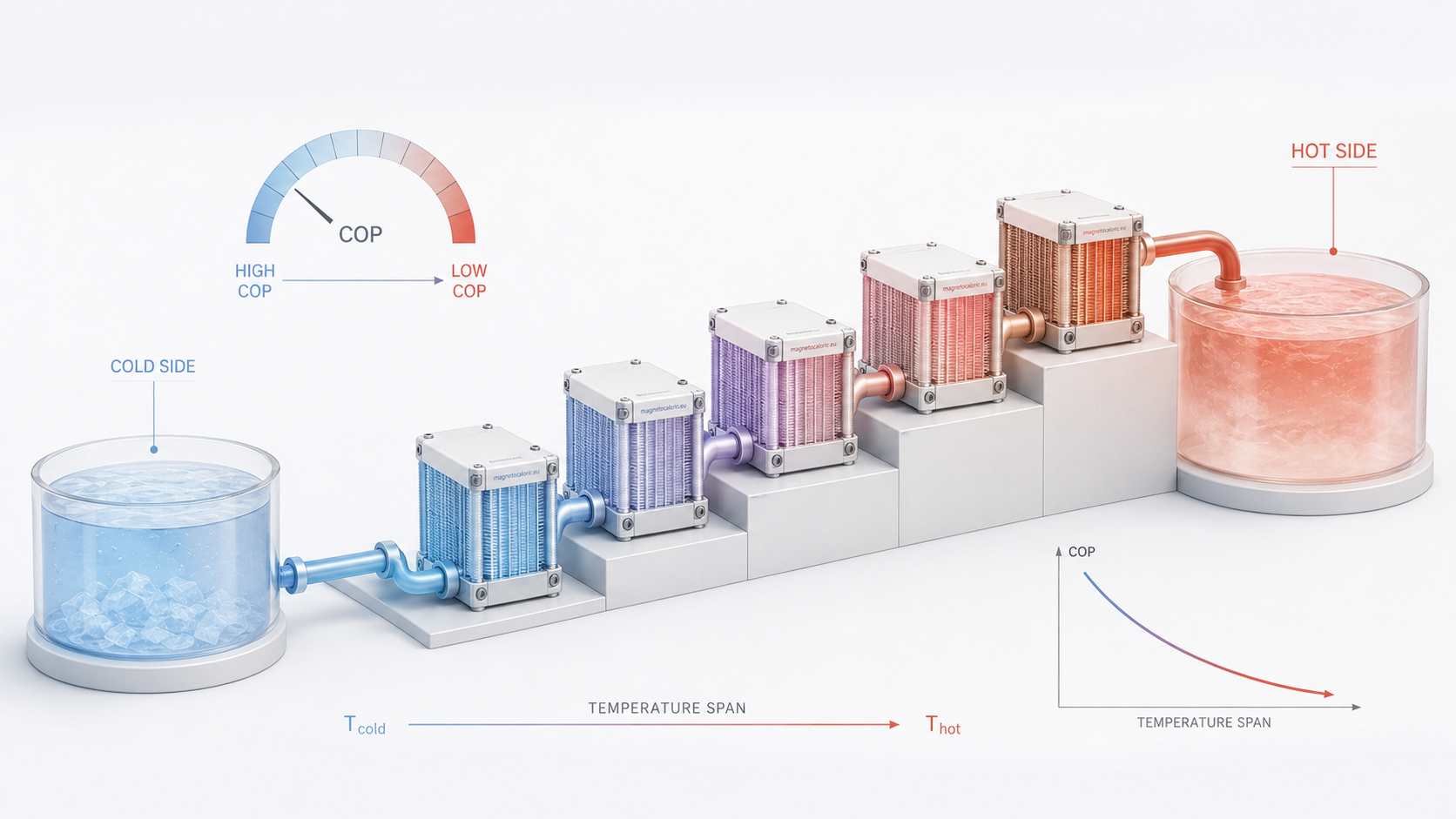
In general, a larger temperature span lowers achievable COP because moving heat across a larger temperature difference requires more work. But real-world heat pump efficiency is not about the largest possible temperature span or capacity. The better goal is to match temperature span and system heat load to the actual application.
COP, Temperature Span, and the Thermodynamic Limit
COP stands for coefficient of performance. It compares useful heating or cooling output with the energy input needed to run the system. For a heat pump, a higher COP means more useful heat per unit of input energy. For a cooling system, it means more heat removed per unit of input energy.
A COP value is meaningful only when the operating conditions are known. One of the most important conditions is temperature span: the difference between the cold side and the hot side of a thermal system [1], [2]. In heat pump applications, this is also often called temperature lift, because the system “lifts” heat from a lower-temperature source to a higher-temperature sink. In cooling, the cold side absorbs heat and the hot side rejects it.
A small temperature span means the two sides are relatively close in temperature. A large temperature span means the system must move heat across a bigger thermal gap. This changes how much work the heat pump, refrigeration system, or cooling system must do.
The reason comes from thermodynamics. In the ideal reversible case, maximum possible performance is set by the hot and cold reservoir temperatures. Real systems perform below this ideal limit because they include irreversibilities and losses [1], [2].
This ideal limit is closely related to the Carnot limit. For heat engines, Carnot efficiency is the maximum theoretical efficiency between two temperatures. For heat pumps and refrigeration systems, the same principle defines the maximum possible COP between a cold side and a hot side. Second law efficiency describes how closely a real system approaches that ideal reversible limit.
As the temperature difference increases, the theoretical maximum COP decreases. Different technologies may reduce losses or improve heat transfer, but the direction is the same: a larger temperature span creates a stronger efficiency challenge.
Temperature Span Is a Cross-Technology Constraint
The relationship between temperature span and COP applies across heat pump and refrigeration technologies. Vapor-compression systems, magnetocaloric systems, and other thermal technologies all move heat from one temperature level to another. No known thermal technology can eliminate the thermodynamic penalty of moving heat across a larger temperature span.
A technology may perform better in a specific temperature range, but it cannot make temperature span irrelevant. That is why a statement such as “this system has a COP of 4” is incomplete unless it also explains the temperature conditions, operating mode, and system boundary.
System Heat Load: How Much Heat Must Be Moved
Temperature span is only one side of the design problem. System heat load is the other.
System heat load describes how much heating or cooling capacity the system must deliver under real operating conditions. In heating, it is the amount of heat the system must supply. In cooling or refrigeration, it is the amount of heat the system must remove.
Two systems can have the same temperature span but very different heat loads. A small refrigeration cabinet and a large industrial cooling process may move heat across a similar temperature difference, but the total heat moved can be very different. This affects equipment sizing, heat exchanger design, auxiliary energy use, and facility-level efficiency.
For this reason, system design should match both the required temperature lift and the required heat load.
Core-Unit, Component, and Facility-Level Efficiency
Performance can be evaluated at different system boundaries.
At the core-unit or cycle level, performance may be expressed using COP or closely related cycle-level performance metrics. Individual components, such as heat exchangers, pumps, fans, or valves, are usually evaluated using measures such as effectiveness, pressure drop, efficiency, heat-transfer performance, or energy losses.
At facility level, the boundary is wider. It may include pumps, fans, controls, backup heaters, heat exchangers, circulation losses, installation quality, and operating strategy. Heat pump monitoring frameworks distinguish between boundaries around the heat pump unit itself and broader boundaries that include auxiliary energy use [3].
This means a high core-unit COP does not automatically guarantee high facility-level heat pump efficiency. System integration matters.
Real-World Operating Conditions Affect COP
Real-world COP changes because real operating conditions change. A heat pump may perform differently depending on outdoor temperature, source temperature, required supply temperature, operating mode, system heat load, system sizing, and installation quality.
Higher output temperatures, such as those often required for domestic hot water, tend to reduce heat pump COP because they increase the required temperature lift. Field and monitoring studies show that heat pump performance can vary across systems and operating conditions [4].
This shows why temperature span and system heat load directly affect real energy performance. The same system can look efficient under one set of conditions and less efficient under another.
Matching Temperature Span and System Heat Load
Temperature span is not only a performance metric. It is also a design variable. The same is true for system heat load, which defines the capacity the system must deliver.
Because COP depends on operating temperatures, system boundaries, and heat load, temperature span and system heat load should be matched to the real application as closely as possible. If a system is designed for a temperature span or heat load larger than the application needs, it may be overdesigned. Overdesign can add cost, complexity, and avoidable efficiency penalties.
If a system is designed for a temperature span that is too small, or for a heat load below the required duty, it may not meet the heating or cooling demand. The most useful system is often the one designed for the right temperature span and the right heat load. Table 1 summarizes how under-specification, over-specification, and application matching affect real-world system performance.
| Design case | Temperature span | System heat load | Outcome |
| Under-specified | Below required lift | Below required heat load | Demand may not be met |
| Over-specified | Above required lift | Above required heat load | Cost and losses may increase |
| Application-matched | Matched required lift | Matched required heat load | Better real-world fit |
Table 1. Matching temperature span and system heat load to the application
Customizable Temperature Span
Customizable temperature span means a thermal system can be configured for the temperature lift required by a specific application. This matters because refrigeration, space heating, industrial processes, and domestic hot water may all require different hot-side and cold-side temperatures, as well as different heat loads.
In modular, staged, or cascaded systems, temperature span can be configured by combining multiple stages or modules. This makes it possible to design around the required temperature lift instead of treating temperature span as fixed.
One example is a modular magnetocaloric architecture. In Magneto’s magnetocaloric system, each 3D-printed magnetocaloric heat exchanger generates about 2°C of temperature span. Multiple heat exchangers can be stacked into a cascade customized to the required dimensions, temperature span, and heating or cooling power. A 40°C temperature span would require about 20 individual heat exchangers [5].
Why This Matters for Customers
For customers, COP should always be connected to temperature span, system heat load, and system boundary.
A high COP at a small temperature span may not represent performance at a larger temperature span. A core-unit COP may not represent full facility-level efficiency. A system designed for the maximum possible temperature span or oversized heat load may not be the most efficient or cost-effective solution.
The better question is: what temperature span and system heat load does the application actually need, and how efficiently can the system operate under those conditions? When the system is matched to the real temperature and heat-load requirement, it can be better sized, easier to integrate, and potentially more efficient in real operation.
Conclusion
Temperature span is central to understanding COP. A larger temperature span generally lowers maximum and practical COP because the system must do more work to move heat across a larger thermal gap. The Carnot limit shows why temperature span sets the theoretical performance ceiling, while second law efficiency explains how closely a real system approaches that ceiling.
But real-world heat pump efficiency also depends on system heat load. Temperature span tells us how far heat must be lifted. System heat load tells us how much heat must be moved.
For real-world heat pump, refrigeration, and cooling efficiency, the goal is not the largest possible temperature span or system capacity. The goal is the right temperature span and the right system heat load for the application. A system designed around the actual temperature lift, heat load, operating conditions, and facility-level boundary is more likely to deliver meaningful energy performance.
References
[1] Çengel, Y. A., Boles, M. A., & Kanoğlu, M. Thermodynamics: An Engineering Approach. McGraw Hill. Available at: https://www.mheducation.com/highered/product/thermodynamics-an-engineering-approach-cengel.html
[2] Jensen, J. K., Ommen, T., Markussen, W. B., & Elmegaard, B. “Heat Pump COP, Part 2: Generalized COP Estimation of Heat Pump Processes.” Technical University of Denmark. Available at: https://backend.orbit.dtu.dk/ws/portalfiles/portal/151965635/MAIN_Final.pdf
[3] IEA Heat Pumping Technologies. “System Boundaries for SPF-Calculation.” Available at: https://heatpumpingtechnologies.org/publications/system-boundaries-for-spf-calculation/
[4] Nature Communications. “Estimation of Energy Efficiency of Heat Pumps in Residential Buildings Using Real Operation Data.” Available at: https://www.nature.com/articles/s41467-025-58014-y
[5] Magneto. “Technology.” Available at: https://magneto.systems/magneto-technology/


