
04 December 2025 | André Beleza, Néel, Grenoble, France
Turning Waste Heat into Useful Energy
Every day, enormous amounts of energy simply get dissipated into the environment as waste heat. This happens everywhere, from the warm air behind a fridge and the heat generated by your laptop, to industrial processes and data centres. Most of this heat is classified as low-grade waste heat (below 100 °C) and is not usually recovered.
In the HEAT4ENERGY project, we aim to change that. Our goal is to convert this low-grade heat, energy that would otherwise be lost, into something useful. To achieve this, I am studying thermomagnetic materials, which exhibit sharp and tunable changes in magnetization near a critical temperature, enabling the conversion of small temperature differences into useful work.
But optimizing these materials is far from straightforward. Their functional properties are extremely sensitive to composition, and this requires us to explore a wide range of elemental ratios to identify the combination that performs best in the intended temperature range.
Reliance on Critical Elements
Some high-performance thermomagnetic materials depend on elements such as rare earths. These are not necessarily rare in the Earth’s crust, but their global supply is heavily concentrated, creating a dependency.
For sustainable energy technologies, we need to either find alternatives or reduce the amount of critical elements used, without compromising performance. That means exploring many different compositions, and this is where another set of challenges begins.
The Combinatorial Approach
Historically, optimizing new materials meant preparing and testing one sample at a time. You would make a bulk sample based on a given composition, characterize it, and then start again with a slightly different composition. This process is slow, labour-intensive, and consumes significant resources.
When trying to explore hundreds of possible alloy combinations, this approach becomes a major bottleneck. To accelerate material optimization, we use the combinatorial thin film approach, where a single wafer contains gradual changes in film composition across its surface. Instead of preparing samples one by one, we can explore an entire materials library in a few wafers.
But to make this more useful, we must also be able to measure these variations quickly and reliably.
High-Throughput Characterization – Big Data
Once one of these graded films is produced, we use high-throughput techniques to measure variations in composition, thickness, crystal structure and magnetic properties at many points across the surface. The “big data” sets associated with graded films processed under different conditions are extremely valuable because they can be analyzed using machine learning (AI) approaches to guide and accelerate materials optimization. Specific data handling tools for the storage, analysis and sharing of our big data sets have been developed in the framework of other on-going projects [1-3].
Seeing the Crystal Structure
A key technique in this workflow is X-ray diffraction (XRD), which allows us to characterise the crystal structure of main and secondary phases in a sample, essential information for understanding its magnetic behaviour. At the European Synchrotron Radiation Facility (ESRF), we take this further using scanning XRD, where we are able to quickly measure diffraction patterns point by point across an entire wafer to create heatmaps of phase fractions and lattice parameters of main and secondary phases.
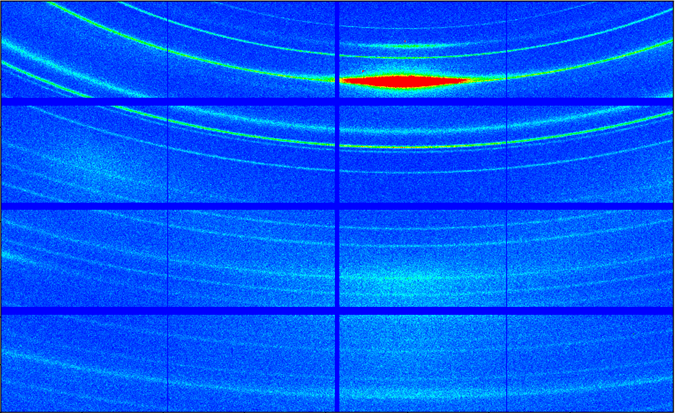
Legend: Example of a 2D X-ray diffraction pattern at a given position on a La(Fe,Si)13 based
Speeding up XRD
To achieve remarkably fast XRD measurements, our approach at the ESRF combines several key components:
- The bright synchrotron source, which provides an intense X-ray beam;
- A motorized XY stage, allowing the wafer to be scanned point by point with high precision;
- A 2D detector, capable of capturing a large portion of reciprocal space in a single snapshot;
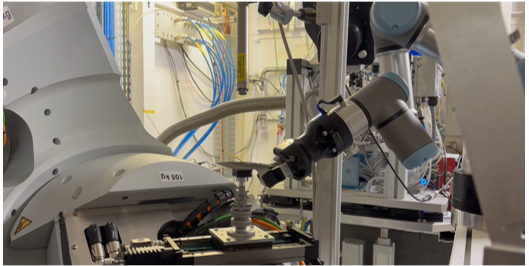
- A robotic arm, enabling automated wafer changes.
The recently installed 2D detector and robot (financed within the PEPR DIADEM-ESRF project), have been commissioned by the BM02 beamline scientists and our team at Institut Néel worked closely with them to develop protocols for automated wafer alignment and measurement sequences.
A full spectrum is acquired in 2 seconds, so that our standard measurement protocol (roughly 250 measurement points across a wafer) takes 45 minutes, and allowing for sample change and alignment, we can process one wafer per hour. Note that a comparable measurement on our lab-based diffractometer takes about 48 hours.
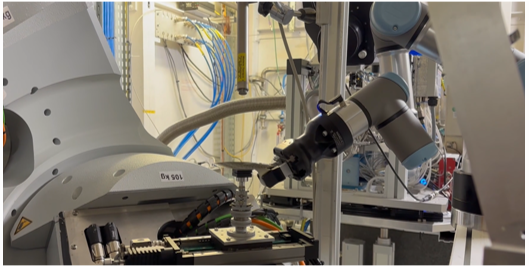
Legend: Automated X-ray diffraction set-up on BM02 @ ESRF
Materials Insights
The structural heatmaps obtained from scanning XRD help us understand how composition affects phase formation and lattice parameters, identify textured material growth, and eventually quantify strain gradients across the film.
All of these parameters are essential for understanding how composition and processing conditions influence the magnetic behaviour. And together, these maps provide a more comprehensive picture of how to optimize thermomagnetic materials for energy harvesting of low-grade waste heat.
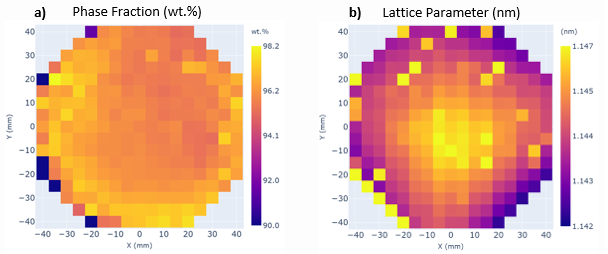
Legend: Heatmaps of the La(Fe,Si)13 phase across the wafer, showing a) phase fraction and b) lattice parameter.
Conclusion
By combining compositionally graded film growth and high-throughput characterization (including scanning XRD with automated sample changes) with machine learning powered data analysis, we can accelerate the discovery and optimization of thermomagnetic materials. This workflow transforms a complex process into a much more efficient one, bringing us closer to harvesting the low-grade waste heat that surrounds us every day.
[1] « Datamag » ANR-FWF (ANR-22-CE91-0008)
[2] « MaMMoS » HORIZON-RIA (Grant number 101135546, HORIZON-CL4-2023-DIGITAL-EMERGING-01)
[3] « MIAM» France 2030 PEPR DIADEM (ANR-23-PEXD-0013)
Attribution: Originally published by HEAT4ENERGY. Reposted with permission. Original article: https://heat4energy.eu/blog/blog-3-tmc-at-esrf-synchrotron


