
Refrigerant-based cooling and heating technologies are everywhere. We use them in refrigerators, air conditioners, supermarket chillers, heat pumps, cars, data centres, hospitals and office buildings. They support comfort, food safety and reliable temperature control. They also play a growing role in the energy transition.
Heat pumps, for example, can replace or reduce reliance on fossil-fuel boilers. Instead of burning gas, they use electricity to move heat. Yet these same technologies rely on refrigerants: special working fluids that can create climate problems when they leak or are poorly managed.
This creates an important sustainability challenge. Refrigerant-based systems can reduce energy use and support electrification, the shift from fossil-fuel systems to electric ones. However, some refrigerants are powerful greenhouse gases. These systems can support decarbonisation, but refrigerant leakage and high-GWP gases can also harm the climate.
How refrigerant-based cooling and heating works
Most air conditioners, refrigerators and heat pumps use the same basic principle. They do not “make cold” or “make heat”; they move heat from one place to another. A refrigerator moves heat from inside the cabinet to the room. An air conditioner moves heat from inside a building to outdoors. A heat pump can use the same process in reverse. It can move heat from outdoor air, water or the ground into a building.
Figure 1 illustrates this basic refrigerant cycle in both cooling and heating mode. In cooling mode, the system removes heat from the indoor space and releases it outdoors. In heating mode, it absorbs heat from outside and delivers it indoors.
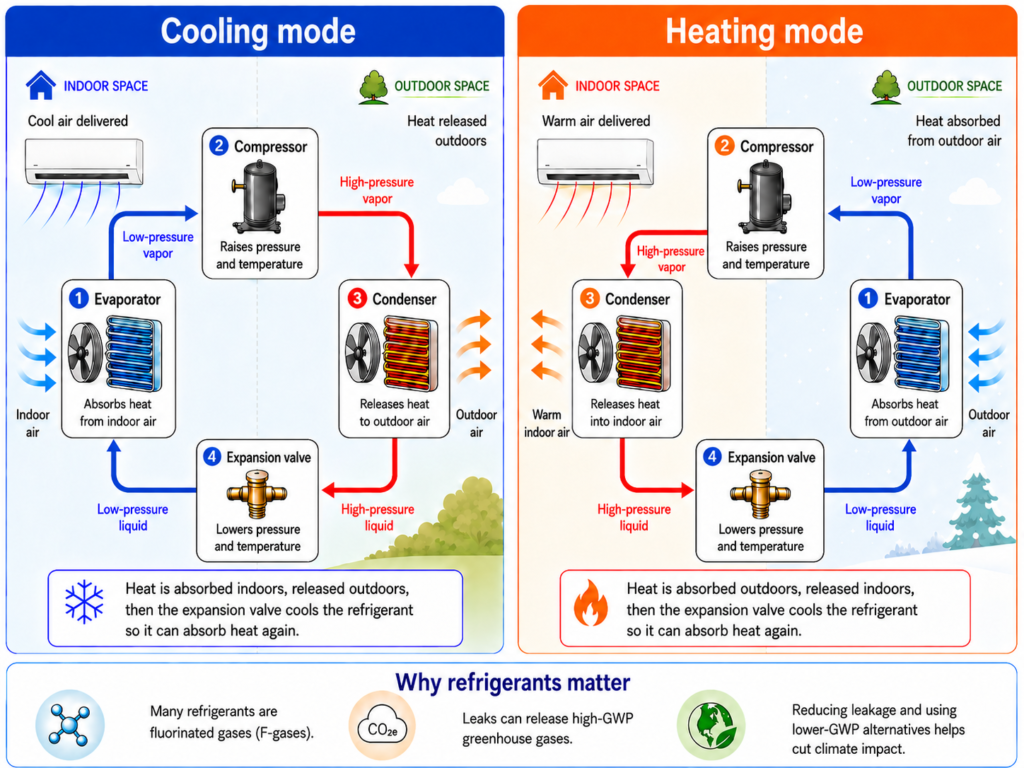
Figure 1. Refrigerant-based cooling and heating cycle. The diagram shows how a refrigerant absorbs and releases heat as it circulates through the evaporator, compressor, condenser and expansion valve.
Figure note: In most residential heat pumps, the same indoor and outdoor coils swap roles between cooling and heating mode using a reversing valve. This simplified diagram focuses on the basic heat-transfer cycle.
The refrigerant cycle
The key to this process is the refrigerant. A refrigerant is a fluid that can easily change between liquid and vapour at useful temperatures and pressures. When it evaporates, it absorbs heat. When it condenses, it releases heat. A cooling or heating system uses this phase change again and again in a closed loop.
The basic cycle has four main parts: the evaporator, compressor, condenser and expansion valve. In the evaporator, the refrigerant absorbs heat and evaporates. In the compressor, its pressure and temperature rise. In the condenser, it releases heat and turns back into a liquid. In the expansion valve, its pressure and temperature drop so it can absorb heat again.
Cooling mode
In cooling mode, the system removes heat from indoor air and releases it outdoors. The indoor evaporator absorbs heat from the room. The compressor then raises the refrigerant’s pressure and temperature. The hot refrigerant releases the heat outdoors through the condenser.
After that, the high-pressure liquid refrigerant passes through the expansion valve. The valve drops the refrigerant’s pressure and temperature. This makes the refrigerant cold again, so it can return to the evaporator and absorb more indoor heat.
Heating mode
In heating mode, the system absorbs heat from outdoor air and releases it indoors. The outdoor evaporator absorbs heat from the outside air. The compressor raises the refrigerant’s pressure and temperature, making it hot enough to heat the indoor space.
The refrigerant then releases this heat indoors through the indoor condenser. After that, it passes through the expansion valve. Its pressure and temperature drop, making it cold enough to absorb heat from the outdoor air again.
In short, the expansion valve “resets” the refrigerant so the cycle can keep repeating. This is why heat pumps can often deliver more heat energy than the electrical energy they consume. They move heat rather than simply converting electricity into heat.
Why refrigerants are an environmental problem
The environmental issue does not only come from the energy used by cooling and heating equipment. It also comes from the refrigerant inside the equipment. Many modern refrigerants are fluorinated gases, often called F-gases. These include hydrofluorocarbons, or HFCs.
Many industries adopted HFCs after older ozone-depleting refrigerants faced restrictions. HFCs do not destroy the ozone layer in the same way as chlorofluorocarbons. However, many HFCs have a high climate impact.
GWP and climate impact
Scientists measure this impact using global warming potential, or GWP. GWP shows how strongly a gas warms the climate compared with carbon dioxide, usually over 100 years [1]. Carbon dioxide has a GWP of 1. This means that if a refrigerant has a GWP of 1,000, leaking just 1 kilogram of it can have about the same climate impact as releasing 1,000 kilograms of carbon dioxide [1].
This matters because even small leaks can have a large climate effect. Designers intend refrigerant systems to be sealed, but real systems can still leak. Leaks can happen during manufacturing, installation, operation, maintenance, repair and disposal.
Small domestic systems, large building systems, supermarket refrigeration racks and industrial cooling systems all need careful management. If refrigerant escapes to the atmosphere, its climate impact depends on two factors: the amount leaked and the GWP of the refrigerant.
Leakage and efficiency
A system with a high-GWP refrigerant may appear clean because it runs on electricity and has no on-site combustion emissions. But if it leaks refrigerant, it can lose part of its climate benefit.
This does not mean heat pumps or air conditioners are inherently bad. It means refrigerant choice, system design, installation quality, leak detection, maintenance and end-of-life recovery all matter. They are essential parts of sustainable HVAC, meaning heating, ventilation and air conditioning.
Leakage also affects energy efficiency. A system with too little refrigerant may not transfer heat properly. It may run longer, consume more electricity and provide poorer comfort. In this way, refrigerant leakage creates direct emissions from the leaked gas and indirect emissions from extra energy use.
Guidance on refrigerant management therefore emphasises leak testing, qualified engineers, record keeping and practical leak-reduction measures [2].
F-gases and regulation
Because many refrigerants are high-GWP fluorinated gases, governments are tightening rules around their use. The European Union’s F-gas Regulation is one of the most important examples. Regulation (EU) 2024/573 was adopted in February 2024 and entered into force on 11 March 2024. It applies to fluorinated greenhouse gases and to products and equipment that contain them or rely on them [3].
The regulation aims to reduce emissions, restrict high-GWP gases in many applications and accelerate the shift to lower-impact alternatives.
EU and Dutch requirements
The regulation includes HFC phase-down, meaning a gradual reduction over time. It also includes restrictions on placing certain equipment on the market, leak prevention requirements, record keeping, recovery and technician certification [3]. These rules affect air conditioning, refrigeration and heat pump markets across the EU, including the Netherlands.
In the Netherlands, technicians and companies working with F-gases and other refrigerants must have appropriate certification. This applies, for example, to work on refrigeration, air-conditioning and heat-pump systems [4]. Mandatory inspection and record-keeping requirements can also apply [4].
This reflects a broader policy direction. Regulators no longer treat refrigerants as a minor technical detail. They increasingly treat them as part of climate management.
Dutch climate and building policy also pushes toward lower-carbon heating, higher efficiency, reduced natural gas use and more electrified systems such as heat pumps. The Netherlands aims to reduce greenhouse gas emissions by 55% by 2030 compared with 1990 levels. It also aims to become climate neutral by 2050 [5]. As heat pumps and cooling systems become more common, refrigerant management becomes even more important.
Why we need alternatives
The demand for cooling and heat pumps is rising. Hotter summers increase air-conditioning demand. Better-insulated buildings still need ventilation, humidity control and cooling. Electrification policies encourage heat pumps to replace gas boilers. Supermarkets, hospitals, laboratories and data centres require reliable cooling all year. Refrigerant-based technologies will remain important, but they must become cleaner.
Climate targets and regulation
There are several reasons why alternatives are needed. First, climate targets require deep emissions reductions. The European Climate Law writes the EU goal of climate neutrality by 2050 into law. It also sets intermediate emissions-reduction targets for 2030 and 2040 [6]. If heating becomes electric but high-GWP refrigerants continue to leak, climate progress becomes harder.
Second, regulation is moving away from high-GWP F-gases. Manufacturers, installers and building owners need equipment that will remain compliant over its lifetime. A system installed today may operate for 10 to 20 years. Refrigerant choices must therefore anticipate future rules, service availability and phase-down schedules.
Third, energy efficiency demands are increasing. The best solution is not simply to choose the lowest-GWP refrigerant. Sustainable HVAC needs both low direct emissions and low electricity consumption. A lower-GWP refrigerant used in an inefficient system may not deliver the best overall result.
Fourth, leakage prevention is essential, but it is not enough on its own. Good maintenance, leak detection, refrigerant recovery and reuse all help. Still, every system carries some risk. Lower-GWP refrigerants reduce the climate damage if a leak occurs.
Refrigerant-management guidance therefore highlights two linked strategies: reducing leaks across the system life cycle and selecting equipment that uses lower-GWP refrigerants [7].
Lower-impact refrigerants and new technologies
This is why many sectors are exploring two kinds of alternatives: lower-impact refrigerants for today’s vapour-compression systems, and emerging technologies that could reduce or avoid conventional refrigerants altogether.
For current vapour-compression systems, lower-GWP options include CO₂, ammonia, hydrocarbons, hydrofluoroolefins, or HFOs, and other refrigerants depending on the application. CO₂, ammonia and hydrocarbons are often called natural refrigerants because they also occur naturally. HFOs, by contrast, are synthetic refrigerants designed for lower climate impact than many older HFCs [8].Each alternative has trade-offs, including pressure, flammability, toxicity, cost or performance. There is no single universal replacement.
Looking further ahead, non-vapour-compression technologies may also become important. Magnetocaloric heat pumps are especially promising because they can provide heating and cooling without conventional refrigerant gases. This could reduce both leakage risks and climate impact. Electrocaloric and other caloric heat-pump technologies are also being explored. Among these options, magnetocaloric technology is currently one of the most promising directions beyond conventional vapour-compression systems.
Finally, refrigerants must be considered across the whole life cycle. This includes production, equipment design, installation, operation, servicing, leakage, recovery, recycling and final destruction. A sustainable cooling and heating strategy is not only about buying efficient equipment. It also means managing refrigerants responsibly from start to finish.
Conclusion
The future of HVAC depends on two transitions at once. We need to move away from fossil-fuel heating, and we need to reduce the climate impact of refrigerants.
In the near term, this means using lower-GWP refrigerants, improving system design, preventing leaks and ensuring qualified installation and maintenance. It also means recovering refrigerants at end of life and improving energy efficiency. These steps can make today’s vapour-compression cooling and heat-pump systems much cleaner. However, they do not remove the refrigerant problem completely.
In the longer term, we also need technologies that reduce or avoid conventional refrigerants altogether. These include natural-refrigerant systems using CO₂, ammonia or hydrocarbons. They also include emerging non-vapour-compression technologies such as magnetocaloric and electrocaloric heat pumps.
Magnetocaloric technology is especially promising and continues to progress, but it is not yet widely deployed as the default market replacement for today’s vapour-compression systems. These alternatives point toward a future where heating and cooling can become cleaner, safer and less dependent on high-GWP refrigerant gases.
References
[1] U.S. Environmental Protection Agency. “Understanding Global Warming Potentials.” EPA. Available at: https://www.epa.gov/ghgemissions/understanding-global-warming-potentials
[2] U.S. Environmental Protection Agency. “Reducing Refrigerant Emissions and Leakage.” EPA / Institute of Refrigeration guidance document. Available at: https://www.epa.gov/sites/default/files/documents/IOR_ReducingRefrigerantEmissions.pdf
[3] European Union. “Regulation (EU) 2024/573 of the European Parliament and of the Council of 7 February 2024 on fluorinated greenhouse gases.” EUR-Lex. Available at: https://eur-lex.europa.eu/eli/reg/2024/573/oj/eng
[4] Business.gov.nl. “Certificates for working with F-gases and other refrigerants.” Government of the Netherlands. Available at: https://business.gov.nl/regulations/certificates-working-with-f-gases/
[5] Government of the Netherlands. “Mitigating climate change.” Available at: https://www.government.nl/themes/nature-and-the-environment/climate-change/mitigating-climate-change
[6] European Commission. “European Climate Law.” Available at: https://climate.ec.europa.eu/eu-action/european-climate-law_en
[7] American Society for Health Care Engineering. “Greenhouse Gas Management of Refrigerants.” ASHE. Available at: https://www.ashe.org/sustainability/decarbonization/management-refrigerants
[8] Taylor & Francis. “Hydrofluoroolefin.” Available at: https://taylorandfrancis.com/knowledge/Engineering_and_technology/Chemical_engineering/Hydrofluoroolefin/


