
12 January 2026 | Eleonora Rusconi, IMEM-CNR, Parma, Italy | Blog
Materials are so ubiquitous that they have almost become invisible. Indeed, we do not realize to what extent the development and commercialization of every object we use and its proper functioning depend on them. No engineering idea could express its full potential without suitable material platforms.
In recent decades, the central role of materials science in the energy transition has become increasingly evident. This realization is also why I chose to work in this field, with the aim of contributing to this transformation.
Hi there, I am Eleonora, one of the PhD students in the Heat4Energy project. My focus is on finding suitable materials for thermomagnetic energy harvesting. Specifically, I work on the synthesis of Heusler compounds: I tailor their chemical composition and design post-synthesis thermal treatments to meet the requirements of the final applications. In a nutshell, my research work and the activities of all Heat4Energy partners are devoted to bringing thermomagnetic technology to the market.
The thermomagnetic motor

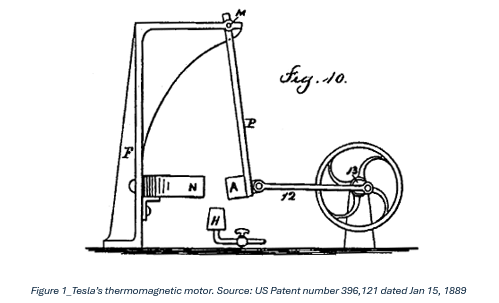
The thermomagnetic motor is an invention of the well-known Nikola Tesla. Because of the absence of a suitable material, it was doomed to lie, forgotten among a multitude of patents in the U.S. patent office. The property of magnetic materials to lose their magnetization at a critical temperature value, known as the Curie temperature, is at the core of Tesla’s invention. Tesla’s prototype consisted of a movable arm, with a soft magnetic material at its tip being pulled in one direction by a spring and in the opposite direction by a permanent magnet. When below its Curie point, the arm is attracted to the magnet and moves to a position where it can be put in contact with a heat source, e.g. a flame. When the temperature rises to the Curie value and above the material loses its magnetization, it swings far from the magnet and cools down. As the initial magnetization state is recovered the cycle can restart. Indeed, it is a simple mechanism to create mechanical motion from a fundamental physical phenomenon. By further development, it is possible to generate electricity by means of an alternator applied to the moving part or by direct application of Faraday’s law of induction. In this last set-up, the variation of magnetic flux inside the turns of a coil is exploited for directly producing a current flow. In fact, each transition across the Curie point results in a magnetization jump.
Why did such an innovative idea fall into oblivion for a century?
Well, it is a great idea, true, but the material choice is poor. The Curie point varies massively amongst different materials. Let’s just consider the three ferromagnetic materials of the periodic table: iron ~ 770 °C, nickel ~ 360 °C, and cobalt ~ 1120 °C. Tesla chose iron to build its prototype as it is easily available and cheap. However, its very high Curie point made the motor not very appealing. Much heat is required for the Curie transition, making the motor highly inefficient.
Due to the lack of suitable materials at the time, the idea was ahead of its era and remained dormant for more than a century. However, in the last years, the field of thermomagnetism has become a scientific hot spot.
What’s up nowadays?
Many devices, beyond the original Tesla’s set-up, are being designed and the quest for the perfect material candidates have started. So, what makes a material suitable?
- appropriate Curie transition temperature
- high magnetization jump across the transition
- low heat capacity which lowers the heat that is necessary to cross the Curie point per unit mass
- high thermal diffusivity for homogeneous and fast heating and cooling processes
Why our work matters
If thermomagnetic generators were brought to the market, the massive waste heat quantity that the human activities produce daily could be recovered and used to produce electricity. Globally, less than 30% of the primary energy carriers are converted to “useful” energy. 50% of the unused share is dispersed into the environment as heat, mostly at temperatures below 100 °C (“low-grade” waste heat). This amount of energy is comparable to more than four years of the EU’s final energy consumption (considering the EU’s energy consumption in 2023: 36 566 PJ).
The bottom line
Technology is tangible. It is made of atoms, impregnated with physics and chemistry. Not by chance, ancient human history is marked by eras named after new material technologies. It is important that we raise awareness of the importance of materials: their design, production, use, end-of-life, together with their characteristics shape our present and future. Hence, if you like, let us know with a thumbs up or a comment if you learnt something new and share to spread ideas.
Thank you!
References:
- Forman, C., Muritala, I. K., Pardemann, R., & Meyer, B. (2016). Estimating the global waste heat potential. Renewable and Sustainable Energy Reviews, 57, 1568-1579, https://doi.org/10.1016/j.rser.2015.12.192
- https://ec.europa.eu/eurostat/statistics-explained/index.php?title=Energy_statistics_-_an_overview#Final_energy_consumption
Attribution: Originally published by HEAT4ENERGY. Reposted with permission. Original article: https://heat4energy.eu/blog/blog-4-why-materials-matter


