
04 February 2026 | Suye, TU Delft, Delft, The Netherlands | Blog
Introduction
You might be surprised to learn that a huge amount of energy we produce every day is simply lost as heat. In fact, industries worldwide release nearly 70% of the total electricity as waste heat. Even more striking is that about 60% of this waste heat is at temperatures below 100 °C, known as low grade waste heat [1]. Unfortunately, this type of heat is especially difficult to reuse efficiently and is therefore mostly released into the environment.
But what if we could turn part of this waste heat into electricity?
This is exactly the challenge addressed by HEAT4ENERGY, an EU-Horizon Europe MSCA Doctoral Network project aiming to develop innovative technologies for harvesting low grade waste heat. I am Doctoral Candidate 1 (DC1) in this project, and my role is to design and optimize thermomagnetic materials—the key building blocks of a thermomagnetic generator. Together with nine other PhD students, each focusing on a different aspect, we are working toward building high-efficiency, real-world thermomagnetic generators that can contribute to a more sustainable energy future.
My Motivation and Goal
Climate change is no longer a distant concern—it is already affecting our planet. Melting ice caps, rising sea levels, and the loss of natural habitats are clear reminders that we need to rethink how we produce and use energy. This is a strong personal motivation behind my research.
What excites me most about thermomagnetic materials is that they can be made from abundant, rare-earth-free elements and synthesized using relatively simple methods. This makes them far more feasible for large-scale and real-world applications. Knowing that my work could contribute to practical, sustainable energy solutions keeps me optimistic and motivated.
The Science Behind My Work
Thermomagnetic generators work based on a fundamental principle of physics: Faraday’s law of induction. Simply put, when a conductor (such as a wire) is exposed to a changing magnetic field, an electric current is generated. In a thermomagnetic generator, permanent magnets provide an external magnetic field, while thermomagnetic materials are used to switch this field on and off. These materials undergo a magnetic phase transition when they are heated or cooled in a magnetic field. For example, one promising thermomagnetic material—(Mn,Fe)₂(P,Si)—changes from a magnetic state to a non-magnetic state when heated, and switches back when cooled [2]. By repeatedly heating and cooling the material, we create a changing magnetic field, which in turn induces an electric current. In this way, part of the waste heat is directly converted into electricity—without moving parts.
Challenges and Breakthroughs
The HEAT4ENERGY project combines materials modeling, materials fabrication and characterization, and demonstrator design. Each of these presents its own challenges.
From a materials science perspective, two major challenges are material efficiency and mechanical stability. Thermomagnetic materials must show a strong and sharp magnetic response, while remaining mechanically robust during repeated heating and cooling cycles.
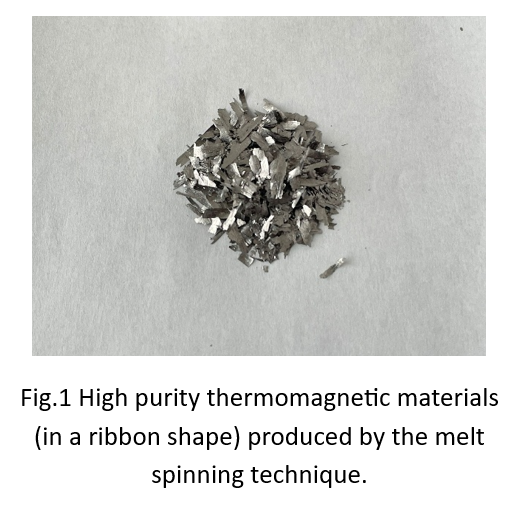
To address this, we focus on designing materials with: High purity, large magnetization change, Low thermal hysteresis, Low latent heat, etc. So far high purity materials with improved properties have been successfully produced by melt-spinning techniques (see Fig.1).

Real-World Impact
Almost everything humans do produces heat—from industrial processes to transportation and data centers. Imagine if part of this constantly released heat could be harvested and reused, much like solar panels harvest sunlight or wind turbines capture wind energy. Thermomagnetic generators offer the possibility to turn this free and continuous energy source into useful electricity. If successfully implemented, this technology could significantly improve the energy efficiency and reduce emissions across many sectors.
Looking Ahead
My next steps focus on further tailoring high performance thermomagnetic materials and identifying new promising candidates. Within the HEAT4ENERGY framework, close collaboration with project partners allows me to test my materials directly in generator demonstrators and further optimize them under realistic operating conditions. By combining fundamental science with real-world testing, we move one step closer to making thermomagnetic energy harvesting a practical solution for sustainable energy generation.
Conclusion
Low grade waste heat is all around us, yet it remains one of the most underutilized energy resources of our time. Through the HEAT4ENERGY project, we are demonstrating how thermomagnetic generators, powered by carefully designed materials, can help turn this overlooked heat into clean and useful electricity. By combining materials innovation, interdisciplinary collaboration, and a strong sustainability vision, our work aims to move the thermomagnetic energy harvesting technology from the laboratory to everyday use. While challenges remain, each step forward brings us closer to a future where waste heat becomes a valuable energy source.
If you are curious about sustainable energy technologies or want to learn more about how fundamental research can drive real-world impact, I invite you to follow the progress of HEAT4ENERGY and join the conversation on how we can use energy more wisely.
Thank you for reading!
References:
[1] European Commission, Directorate-General for Energy, EU energy in figures: statistical pocketbook 2024, Publications Office of the European Union, 2024.
[2] W. Hanggai, H. Yibole, F. Guillou, C. Kwakernaak, N.H. van Dijk, E. Brück, Preparation of Fe-rich giant magnetocaloric (Mn,Fe)2(P,Si) ribbons and calorimetric analysis of the first-order magnetic transition, Acta Materialia, Volume 302, 121677, 2026.
Attribution: Originally published by HEAT4ENERGY. Reposted with permission. Original article: https://heat4energy.eu/blog/blog-5-turning-waste-heat-into-electricity-my-journey-with-heat4energy


