
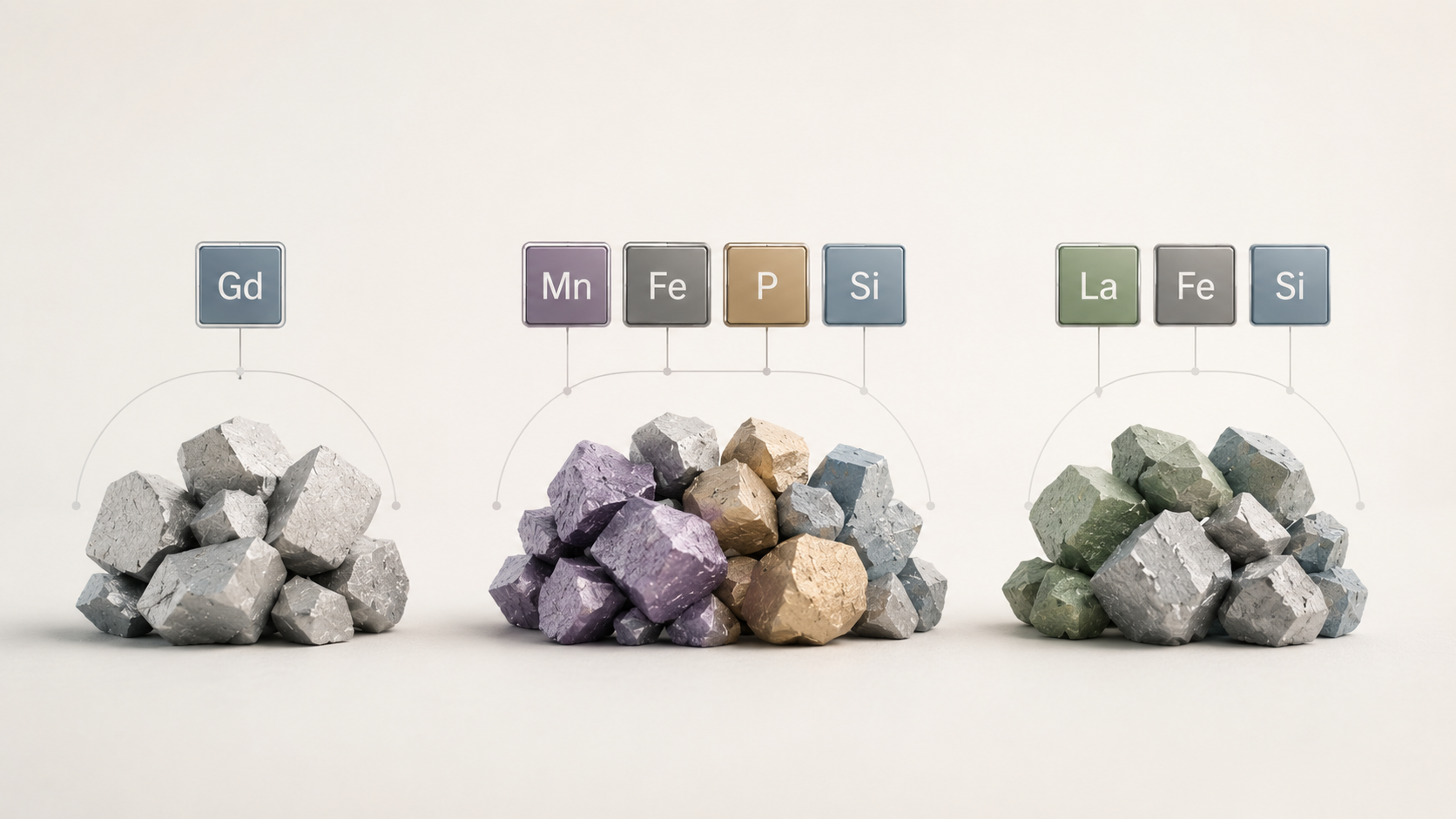
Heating and cooling are still built around a familiar idea. Compress gas, move heat, and accept the cost of electricity use and climate impact. Magnetocaloric technology offers a different route. It uses a solid material that warms up in a magnetic field and cools down when that field is removed. No conventional refrigerant gas sits at the center of the cycle. That alone makes it worth paying attention. [1]
The story of magnetocaloric cooling often begins with gadolinium, or Gd. For decades, Gd has been a reference material because it shows a clear magnetocaloric effect close to room temperature, with a Curie temperature around 294 K. [2] Gd is also a second-order magnetocaloric material. [3] That means its magnetic transition is smooth and relatively stable, without the abrupt structural change seen in many first-order materials. [3] This makes Gd scientifically useful and mechanically forgiving. But it also shows why a benchmark material is not automatically a commercial solution. As a rare-earth metal, Gd can raise cost, availability, and supply-chain concerns. [4] Its useful operating window is also limited compared with what a practical heat pump needs. [2][3] A real system must operate across a broader temperature span, not only near one ideal point.
What matters now is not whether this effect exists. That question is settled. What matters is which material family can carry the technology into real products. That is where the field has moved beyond Gd. Novel inter-metallic alloys have been developed that exhibit a strong first-order magnetocaloric transition. [5] This first-order magnetic transition is strongly coupled to a structural transition, which can produce a stronger magnetocaloric response. [3][5] That stronger response is one reason first-order materials are attractive, but it is also why they are more difficult to commercialize. Historically, first-order materials have had to overcome hysteresis, incomplete transitions, mechanical stress, fatigue, and the difficulty of turning peak laboratory performance into reliable machine performance. [3][5]
The most promising first-order material families based on current research are MnFePSi and LaFeSi. Both combine strong magnetocaloric performance with the qualities that matter in an actual machine, wide temperature tunability, low hysteresis, and strong low-field cycling behaviour. Those are the traits that can turn an exciting material into a usable heat pump platform. [1][6][7]
In other words, Gd helped establish magnetocalorics as a serious scientific field. [2][3] MnFePSi and LaFeSi are the material families now helping move that discussion closer to practical heat pump design. [6][7] For companies working in this space, the opportunity is to translate that material progress into reliable, scalable hardware.
Peak Lab Results Do Not Guarantee Real Performance
For years, magnetocaloric materials were often judged by their peak entropy change. That seems reasonable at first. A bigger peak should mean a better material. In practice, the picture is more complex.
A heat pump does not run once. It runs continuously, cycle after cycle. That means the refrigerant material must keep performing under repeated use and under magnetic fields that are realistic for commercial machines. This is why researchers have pushed for a more practical metric, the coefficient of refrigerant performance, or CRP. While COP describes the efficiency of the full heat pump system, CRP focuses on the refrigerant material itself. It tells you how much useful cooling the material gives back for the energy put into it. In the literature, CRP is especially valuable because it captures the effect of hysteresis and incomplete phase transitions, which can reduce real cycle performance even when headline material properties look strong. It is also a more relevant screening tool at the roughly 1 tesla field levels expected in commercial machines, rather than the much higher fields often used in lab measurements. [1][8]
That change in perspective matters because some materials look excellent in one-off measurements but lose ground once repeatability is tested. Commercially useful material needs more than a dramatic peak. It needs low losses, stable cycling, and strong performance under realistic operating conditions.
This is also why the Gd comparison is useful. Gd is stable and well understood, but its rare-earth dependence and relatively narrow useful temperature window make it difficult to see as the main route for broad heating and cooling markets. [2][3][4] The practical question is no longer only “can a material show the magnetocaloric effect?” It is also “can the material deliver useful heat-pump performance again and again, at realistic field strengths, in a manufacturable system?”
Why First-Order Magnetocaloric Materials Are Promising for Practical Heat Pumps
Two material families appear again and again in the research on room temperature magnetocaloric systems, LaFeSi and MnFePSi. Both are serious contenders. Both have strong scientific backings. But they do not offer the same path to the market.
MnFePSi stands out first because of its large tunability of the operation temperatures. The MnFePSi phase diagram shows that its Curie temperature can be tuned across an exceptionally wide range, from about 65 K to 470 K. [6] For comparison, VAC lists its CALORIVAC magnetocaloric alloys as covering a temperature range from 100 K to 350 K. [9] In plain language, that means these material families can be tailored for applications that range from deep cooling to high-temperature heating. That breadth is rare, and it matters. Real heat pumps need a sequence of compositions tuned to different temperatures across the regenerator, not one perfect material at one point. [6]
This is one of the clearest advantages over Gd. Gd is valuable as a reference point near room temperature, but first-order materials like MnFePSi and LaFeSi behave more like materials platforms. [2][3][6][9] Their compositions can be adjusted so that different layers of the same material family operate at different points in the heating or cooling cycle. [6][10] That is exactly what a practical regenerator needs.
MnFePSi also keeps that flexibility without losing the characteristics that make magnetocaloric material useful in the first place. Low hysteresis can be achieved in promising compositions, and that is crucial for repeated cycling. [6][7]
Then there is a low-field efficiency story. This is where MnFePSi becomes especially convincing. Comparative CRP data suggest that reported MnFePSi compositions can perform especially well on this cycle-relevant metric. [1][7] One reported MnFePSi composition reached a CRP of 0.78 at 1 T, while representative LaFeSi-based materials in the same comparison reached 0.63 and 0.37. [7] The reason is simple but important. MnFePSi materials can combine very low hysteresis with more complete field-induced transitions. [7] In a commercial machine, that matters more than a flashy peak number. [1][7]
From Strong Materials to Practical Heat Pump Design
Promising material is only the start. The bigger challenge is turning that material into a heat pump that performs well across changing operating conditions.
Research on active magnetic regenerators shows that layering different MnFePSi compositions across the regenerator bed is a practical way to improve heating performance. One study found that linear Curie temperature distributions work better than sigmoidal distributions for maintaining robust heating across a realistic temperature span. That is not just a material result. It is a design result. It shows that MnFePSi behaves like a platform engineers can actually build around. [10]
System level modeling strengthens that picture. In residential heat pump modeling based on MnFePSi, a 12-layer active magnetic regenerator operating with a maximum applied field of 1.4 T delivered a modeled maximum COP of 5.8 and a seasonal COP of 5.6. These are modeled outcomes, not product claims, but they are important signals. They show that strong material behaviour can translate into strong system potential under realistic low-field conditions. [11]
That is exactly the kind of evidence that matters for companies working to industrialize magnetocaloric hardware. For general readers, it means this is no longer just an elegant lab effect. For OEMs, it suggests that the material can support real design architectures. For investors, it points to a technology path that is becoming clearer and more credible.
This is where industrial development becomes important. The missing piece in magnetocalorics is not only the basic science, but also translation: selecting suitable materials, shaping them into working regenerators, managing field strength, controlling heat exchange, and building machines that can operate reliably outside the lab. That broader engineering effort is what can move magnetocaloric technology from material promise toward product reality.
Why Durability Matters as Much as Performance
Performance is only half of the story. The other half is endurance.
First-order materials can suffer when repeated cycling creates internal stress. If the structural change at the magnetic transition is too large, cracks, fatigue, and performance loss become real concerns. MnFePSi appears to have an advantage here as well. The literature points to lower transition-related strain and strong cyclability in MnFePSi compositions, while LaFeSi has been associated with greater mechanical challenges and a heavier processing burden, especially when hydrogenation is needed to tune the operating range. [7][12][13]
This is an important commercialization lesson from the history of the field. Gd is stable but limited by rare-earth dependence and operating range. [2][3][4] Some first-order materials show strong responses but can introduce losses and durability concerns. [3][5] MnFePSi is compelling because it appears to offer a useful balance: strong first-order performance, broad tunability, low hysteresis in promising compositions, and a credible path toward repeated cycling. [6][7]
This matters because durability is not a side issue. It sits at the center of commercialization. A material that performs well but degrades too quickly is not a solution. A material that combines efficiency, tunability, and mechanical stability is far more valuable.
Why MnFePSi Is Becoming a Serious Candidate
The case for magnetocaloric heat pumps is no longer built on curiosity. It is built on convergence. The energy system needs cleaner heating and cooling. The materials science is getting sharper. And the best candidates are becoming easier to identify.
MnFePSi stands out because it addresses several of the requirements that matter most. It is rare earth free. It is tunable across a very wide temperature range. It performs strongly under low magnetic fields. It supports layered regenerator design. And it appears better suited for long-term cycling than some of its closest rivals. [1][6][7][10][11]
Gd remains an important benchmark for understanding the magnetocaloric effect near room temperature. [2][3] But practical heat pump design also needs broad tunability, low losses, stable cycling, and system-level integration, areas where MnFePSi has become a serious candidate. [1][6][7][10][11] The field does not only need materials that prove the magnetocaloric effect exists. It needs material platforms that can support practical device design, stable operation, and realistic manufacturing routes. MnFePSi is emerging as one of the material families that could help meet those needs.
That is why this material family matters so much. It does not just make magnetocaloric heat pumps possible. It makes them look buildable.
For companies developing the core hardware for this next generation of systems, that is the real opportunity. The most useful material may not be the one with the most dramatic lab result. It is more likely to be one that can be manufactured, integrated, cycled, and trusted. Right now, MnFePSi looks increasingly like one of the serious candidates for that role.
For companies like Magneto, that bridge is the technical focus: helping turn promising first-order magnetocaloric materials such as MnFePSi into commercially relevant heat pump platforms.
References
[1] Brück, E., Yibole, H., Zhang, L. “A Universal Metric for Ferroic Energy Materials.” Philosophical Transactions of the Royal Society A 374, 20150303, 2016.
[2] Dan’kov, S. Yu., Tishin, A. M., Pecharsky, V. K., Gschneidner, K. A., Jr. “Magnetic Phase Transitions and the Magnetothermal Properties of Gadolinium.” Physical Review B 57, 3478 to 3490, 1998.
[3] Waske, A., Gruner, M. E., Gottschall, T., Gutfleisch, O. “Magnetocaloric Materials for Refrigeration Near Room Temperature.” MRS Bulletin 43, 269 to 273, 2018.
[4] Booten, C., Mann, M., Momen, A., Abdelaziz, O. “Critical Material Supply Chain Analysis: Magnetocalorics.” National Renewable Energy Laboratory, NREL/TP-5500-75163, 2020.
[5] Hussain, R., Cugini, F., Baldini, S., Porcari, G., Sarzi Amadè, N., Miao, X. F., van Dijk, N. H., Brück, E., Solzi, M., De Renzi, R., Allodi, G. “Ubiquitous First-Order Transitions and Site-Selective Vanishing of the Magnetic Moment in Giant Magnetocaloric MnFeSiP Alloys Detected by 55Mn NMR.” Physical Review B 100, 104439, 2019.
[6] You, X., Maschek, M., van Dijk, N. H., Brück, E. “Magnetic Phase Diagram of the MnxFe2−xP1−ySiy System.” Entropy 24, 2, 2022.
[7] Guillou, F., Yibole, H., Porcari, G., Zhang, L., van Dijk, N. H., Brück, E. “Magnetocaloric Effect, Cyclability and Coefficient of Refrigerant Performance in the MnFe(P,Si,B) System.” Journal of Applied Physics 116, 063903, 2014.
[8] Wood, M. E., Potter, W. H. “General Analysis of Magnetic Refrigeration and Its Optimization Using a New Concept, Maximization of Refrigerant Capacity.” Cryogenics 25, 667 to 683, 1985.
[9] VACUUMSCHMELZE. “Magnetocaloric Material – CALORIVAC.” VACUUMSCHMELZE, accessed 2 June 2026.
[10] Pineda Quijano, D., Infante Ferreira, C., Brück, E. “Layering Strategies for Active Magnetocaloric Regenerators Using MnFePSi for Heat Pump Applications.” Applied Thermal Engineering 232, 120962, 2023.
[11] Pineda Quijano, D., Fonseca Lima, B., Infante Ferreira, C., Brück, E. “Seasonal COP of a Residential Magnetocaloric Heat Pump Based on MnFePSi.” International Journal of Refrigeration 164, 38 to 48, 2024.
[12] Paul-Boncour, V., Bessais, L. “Tuning the Magnetocaloric Properties of the La(Fe,Si)13 Compounds by Chemical Substitution and Light Element Insertion.” Magnetochemistry 7, 13, 2021.
[13] Kaeswurm, B., et al. “Behaviour of the Young’s Modulus at the Magnetocaloric Transition in La(Fe,Co,Si)13.” Journal of Alloys and Compounds 697, 427 to 433, 2017.


