
The race has moved beyond “can this work?”
A heat pump is a machine that moves heat from one place to another instead of generating heat directly. That matters because moving heat is usually much more efficient than making it from scratch. In building-relevant operating ranges, conventional vapor-compression heat pumps — the familiar systems used in most air conditioners and heat pumps today, where a refrigerant is compressed and expanded in a cycle — typically operate at about 40% to 60% of Carnot efficiency. Carnot efficiency is a theoretical benchmark that compares a real machine with the best possible machine working between the same hot and cold temperatures. By contrast, current caloric heat-pump prototypes more often top out around 20% of Carnot efficiency. Even so, a pattern has become clear: magnetocaloric and elastocaloric systems are now the closest solid-state challengers, and magnetocaloric has the strongest measured system record so far.[1]
That matters because heating, cooling, and hot water already account for a large share of energy use in homes, supermarkets, offices, hospitals, and factories. The latest SINTEF overview compares the four main caloric routes with conventional vapor-compression heat pumps and is based on 209 scientific publications and public technical reports, which makes it a strong snapshot of where the field stands today.[1]
Four solid-state routes are competing for the same future
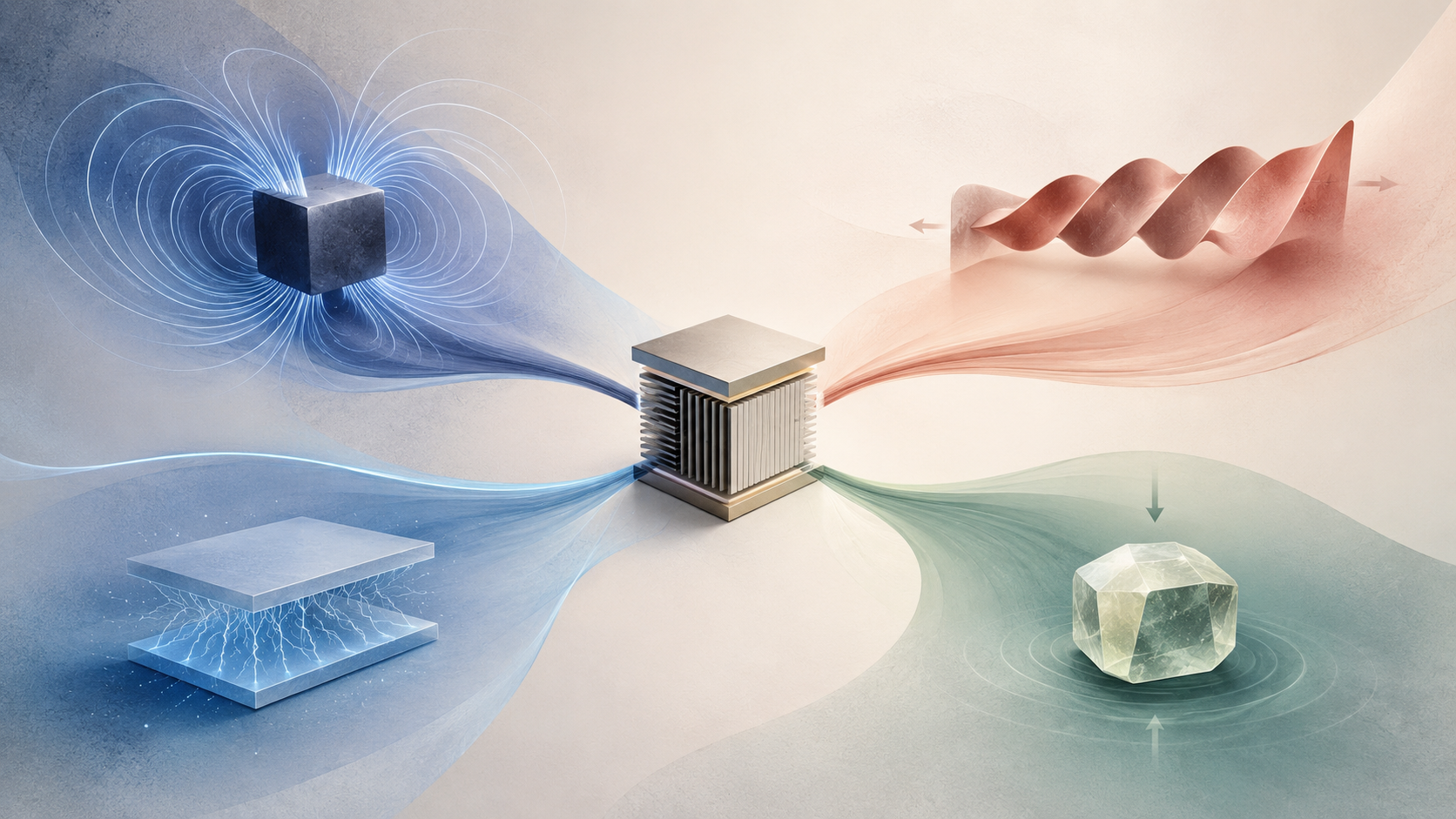
A caloric heat pump is a heat pump built around a solid material that changes temperature when an external field or force changes. In a magnetocaloric system, the material responds to a magnetic field. In an elastocaloric system, it responds to mechanical stress, such as stretching or compression. In an electrocaloric system, it responds to an electric field. In a barocaloric system, it responds to pressure. In each case, the basic idea is the same: a solid material warms up or cools down, and that temperature change is converted into useful heating or cooling.[1]
These systems are often called solid-state heat pumps because the active heating or cooling effect comes from a solid material rather than from evaporating and compressing a refrigerant gas. That does not mean the whole machine contains no liquid. Many caloric systems still use a heat-transfer fluid, which is a liquid that carries heat through the device.[1]
How a caloric system turns a small effect into useful heating or cooling
Most caloric systems use an active regenerative cycle. A cycle is the repeating sequence of steps that produces heating or cooling. Regeneration means the device stores and reuses heat internally so that many small temperature changes can build into a larger overall temperature difference. In practice, the machine repeatedly applies and removes the external field while pushing fluid back and forth through the active material. That is how a small material-level effect becomes a usable system-level effect.[1]
To compare the four caloric routes fairly, three numbers matter most: COP, temperature span, and useful power output. COP, or coefficient of performance, is the standard efficiency metric for a heat pump. A COP of 4 means the system delivers four units of heating or cooling for every one unit of electricity it uses. Temperature span is the temperature difference between the cold side and the hot side that the system can create or bridge. Useful power output is the actual amount of heating or cooling the machine can deliver, usually measured in watts, the standard unit of power. The SINTEF review uses these three metrics throughout and also warns that published COP values are not always calculated in exactly the same way, so some reported values may be optimistic if not all losses are included.[1]
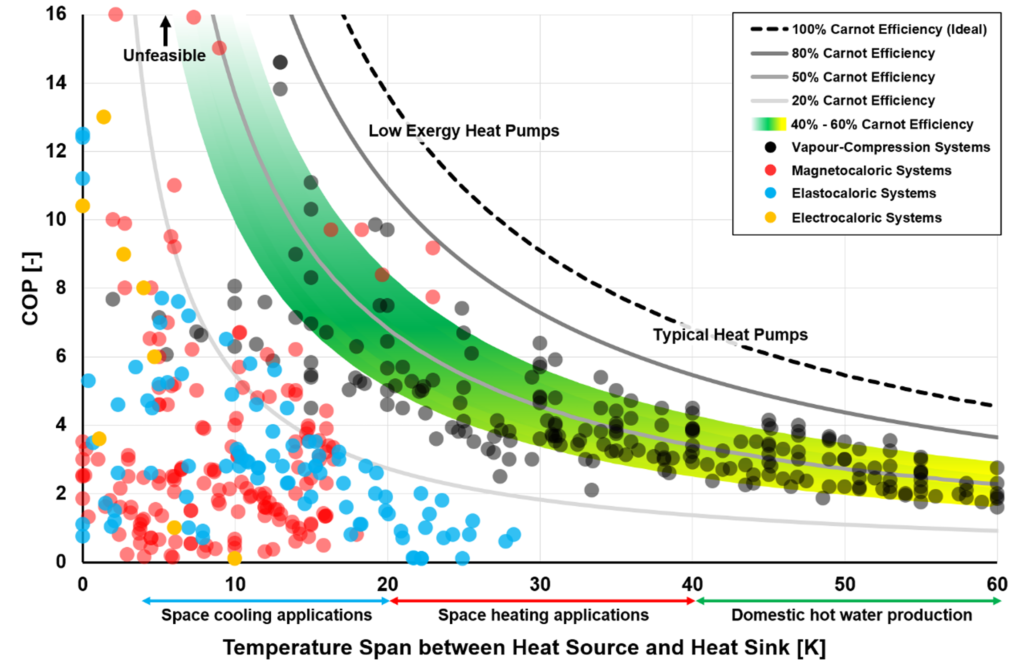
Figure 1. COP versus temperature span across measured caloric and vapor-compression heat-pump prototypes.
Measured hardware shows why magnetocaloric and elastocaloric systems are currently the closest solid-state challengers, while also showing that temperature span remains a major bottleneck.[1]
Figure 1 compares measured prototypes only, not simulated future designs. That matters because it shows what different heat-pump routes have actually achieved in hardware. The chart plots COP against temperature span. The conventional vapor-compression cluster still occupies the strongest overall position, but the measured caloric results show that magnetocaloric and elastocaloric are the two closest solid-state challengers in building-relevant operating ranges.[1]
Temperature span is still one of the hardest bottlenecks
Across measured prototypes, magnetocaloric and elastocaloric systems are still mostly limited to about 20–30 K of temperature span. A kelvin, written as K, is the same size as a degree Celsius when describing a temperature difference, so 20–30 K means roughly 20–30°C of lift from one side of the system to the other. That is enough for part of the heating and cooling market, but still short of what many higher-temperature heating and hot-water applications require. Simulation results suggest that all four caloric families could eventually operate at higher temperature lifts while maintaining good COPs, but measured hardware has not broadly reached that point yet.[1]
Power output is where the field really starts to separate
A strong temperature span alone is not enough. A system can create a useful temperature difference and still be far from market if its power output is too small. That is why the next comparison matters: it asks not just how efficiently a prototype runs, but whether it can deliver enough heating or cooling to matter outside the lab.[1]
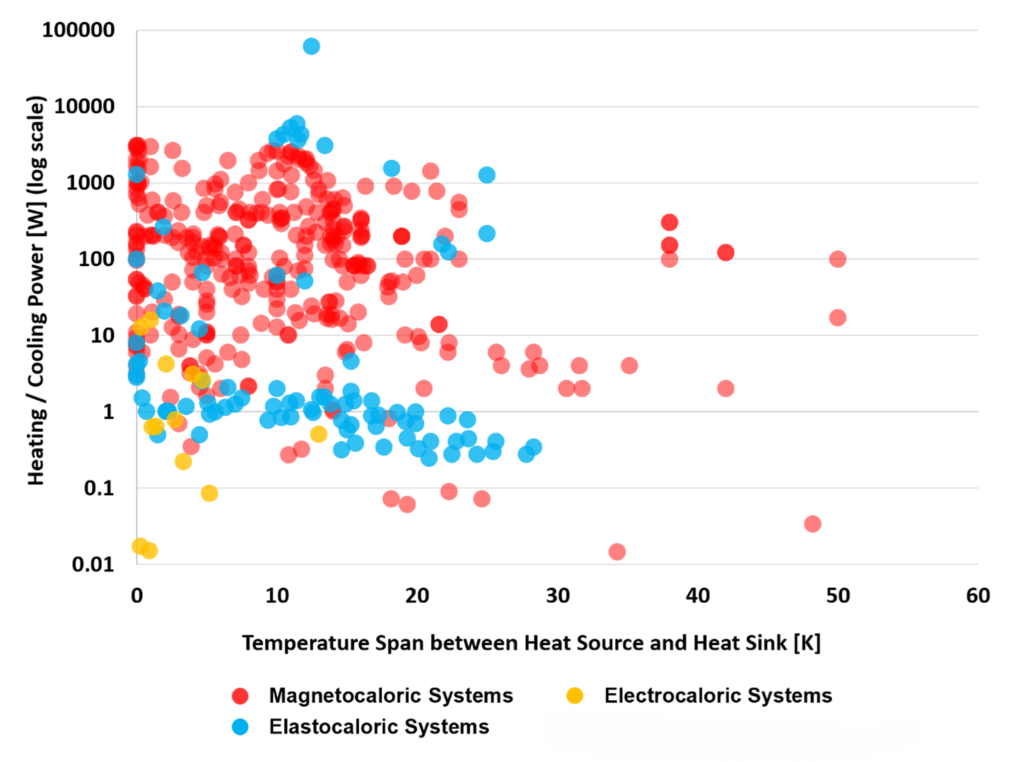
Figure 2. Heating/cooling power output versus temperature span across measured caloric prototypes. Barocaloric systems are not plotted because the available system-level results are still dominated by simulations rather than measured prototype performance.
Figure 2 shows where the field separates most clearly at system level. It plots heating or cooling power output against temperature span using measurement data only, so the comparison stays grounded in prototypes that have actually been built and tested. This makes magnetocaloric’s current advantage especially clear. In the chart, magnetocaloric prototypes extend further into the region that combines useful output with useful temperature span, while most elastocaloric and electrocaloric prototypes remain clustered at much lower output levels. According to the SINTEF overview, apart from a few elastocaloric devices, only magnetocaloric prototypes currently combine a building-relevant temperature span with heating or cooling power output that is sufficient for building applications. Most measured elastocaloric and electrocaloric prototypes still remain below 10 W, while barocaloric is not included here because its present results are still dominated by simulation rather than measured prototype performance.[1]
Why magnetocaloric leads today
Magnetocaloric heat pumps are leading not because the concept is simpler, but because they have progressed further as complete machines. Some early magnetocaloric prototypes reported very large temperature spans and very high COPs by using superconducting magnets, which can generate very strong magnetic fields but are expensive and complex because they often require very low operating temperatures. The more commercially relevant progress came later. Within the last ten years, magnetocaloric prototypes using permanent magnet assemblies — arrangements of permanent magnets that create the needed magnetic field without superconducting cooling — began reaching significant temperature spans, appreciable COPs, and useful power outputs suitable for building applications.[1]
At the same time, elastocaloric is the strongest challenger. The SINTEF overview says elastocaloric has recently reached appreciable performance in COP, heating or cooling power, and temperature span that is now comparable to the best magnetocaloric prototypes. By contrast, electrocaloric prototypes still remain limited in effective output and span, while barocaloric system data is still extremely limited.[1]
The bottleneck is shifting from materials to system engineering
The central challenge is no longer only the size of the single-stage caloric effect. It is whether a full machine can turn many small temperature changes into a larger practical temperature span without losing too much efficiency to pumps, valves, motors, controls, or poor fluid flow. In other words, the field is shifting from “does the material work?” to “does the whole system still work once real engineering losses are included?”
One example of this system-focused direction is Magneto, which describes its platform as 3D-printed magnetocaloric heat exchangers based on Mn-Fe-P-Si, a magnetocaloric material family made from manganese, iron, phosphorus, and silicon. A heat exchanger is the part of a system that transfers heat between the active material and a fluid. On its current website, Magneto describes this material platform as rare-earth-free, non-toxic, and operable across a temperature range from -80°C to 200°C. The company also says each 3D-printed heat exchanger generates a temperature span of about 2°C, and that a 40°C system-level span can be built by stacking about 20 heat exchangers into a cascade, meaning a sequence of stages where each stage adds a little more temperature lift.
Magneto also describes its active magnetic regenerator, or AMR, as the core component of a magnetocaloric heat pump. A regenerator is the part of the system that repeatedly exchanges and stores heat during the cycle. According to the company’s technology page, the AMR uses a water-based heat-transfer fluid and a geometry designed to reduce water-flow resistance, meaning resistance to fluid movement through narrow channels. Lower flow resistance matters because it can reduce pumping energy. The company also says it uses a corrosion-protection approach for Mn-Fe-P-Si components. These are best treated as company-described engineering choices, not as independently verified peer-reviewed performance results. Their importance is that they target exactly the bottlenecks the broader field now highlights: practical temperature span, lower pumping losses, and manufacturable heat-exchanger geometry.
Which route is closest to market?
Once the problem is framed at system level, the field no longer looks like a four-way tie. Magnetocaloric has the strongest measured system position today. Elastocaloric is the strongest challenger. Electrocaloric remains promising but underpowered at device level. Barocaloric still lacks enough demonstrated systems to make a comparable market case.[1]
The next stage of competition will be shaped less by which caloric effect looks most elegant in a laboratory and more by which route first combines high temperature span, strong COP, useful power output, and manufacturable system design in the same machine. Right now, based on the SINTEF performance overview and the measured-prototype comparisons in Figure 1 and Figure 2, magnetocaloric is the closest to doing that.[1]
References
[1] H. Johra, Performance Overview of Caloric Heat Pumps: Magnetocaloric, Elastocaloric, Electrocaloric, and Barocaloric Systems – Update 2025. SINTEF Notes 58, SINTEF Academic Press, 2025.
[2] Magneto, company website, especially homepage and technology page, accessed May 2026.


