
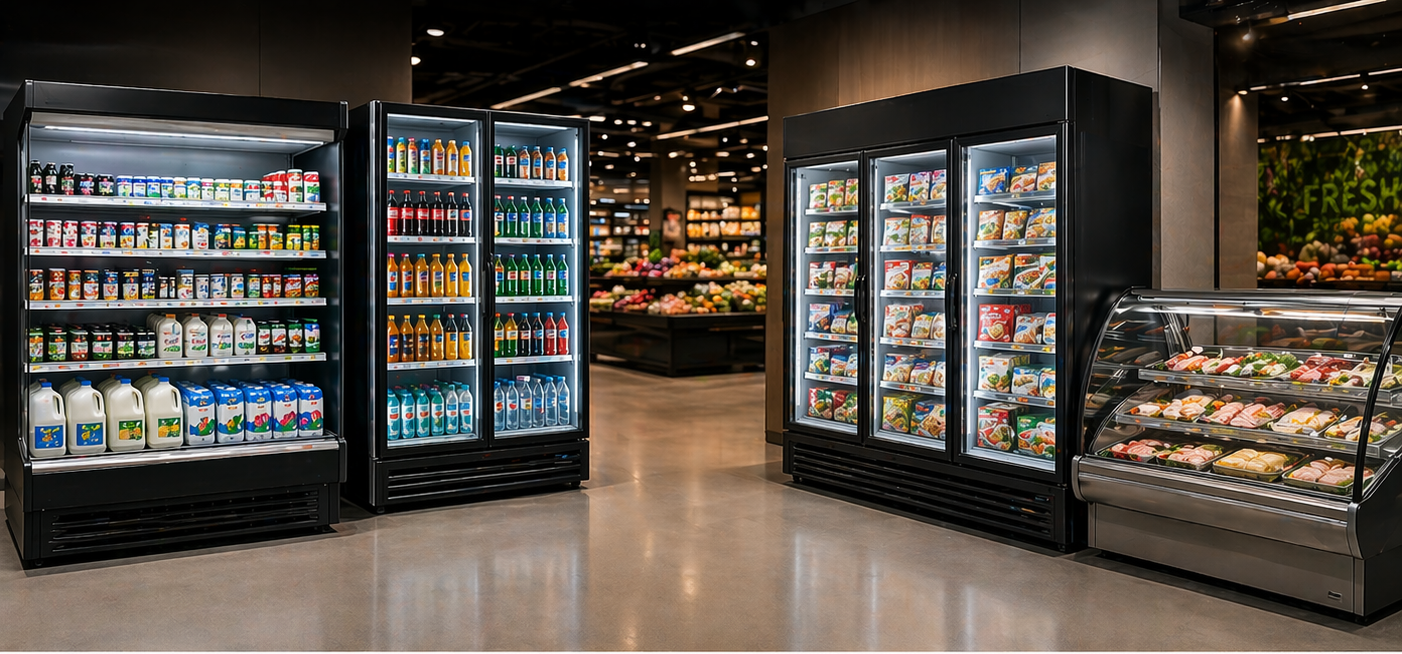
For over 100 years, refrigerators and air conditioners have relied on vapor compression, a process that uses chemical refrigerants to move heat. While effective, many of these gases are potent greenhouse agents. Magnetocaloric cooling offers an alternative solid state cooling technology: it uses solid magnetic materials and a cycling magnetic field to generate cooling, rather than relying on refrigerant gases and vapor compression processes [1].
1. What is a Magnetocaloric Cooling & Heating System?
A magnetocaloric cooling system is a solid-state refrigeration technology that relies on the magnetocaloric effect (MCE) to transfer heat. Certain magnetic materials change temperature when exposed to a magnetic field: they heat up when magnetized and cool down when the field is removed [2,3].
In other words, the magnetic material itself acts as the refrigerant. No gas required. By cycling the material through magnetization and demagnetization while transferring heat via a fluid, these systems can function as refrigerators, air conditioners, or heat pumps [3,1].
Today, research groups and companies are developing room-temperature magnetocaloric prototypes based on permanent magnets, targeting homes, buildings, and industrial applications [4]. This emerging ecosystem includes material innovators such as Magneto B.V. and TU Delft, whose rare-earth-free Mn–Fe–P–Si platform, and TU Darmstadt, whose Lanthanum based platform, provide a scalable material foundation for magnetocaloric prototypes. It also includes applied materials and testing institutes with complementary roles: Fraunhofer IFAM (Fraunhofer-Institut für Fertigungstechnik und Angewandte Materialforschung) supports magnetocaloric material processing, manufacturing, reliability assessment, and measurement standards, while BAM (Bundesanstalt für Materialforschung und -prüfung) contributes broader expertise in materials research, testing, safety assessment, reference materials, and standardization. Rare-earth research institutions such as BRIRE (Baotou Research Institute of Rare Earths) contribute expertise in rare-earth materials, testing, and evaluation. Meanwhile, system developers such as Magnoric, Magnotherm, and POLO UFSC (Polo – Research Laboratories for Emerging Technologies in Cooling and Thermophysics ) translate material platforms into cooling hardware and heat-pump prototypes, including performance testing at the system level. Together, these organizations connect materials science, manufacturing, system design, testing, standardization, and heat-pump performance evaluation across the emerging magnetocaloric cooling ecosystem [5–12].
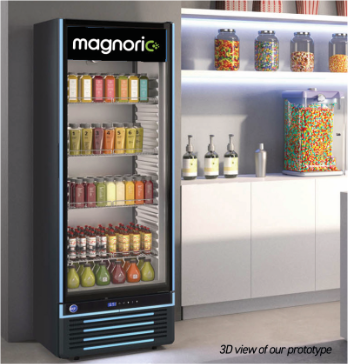
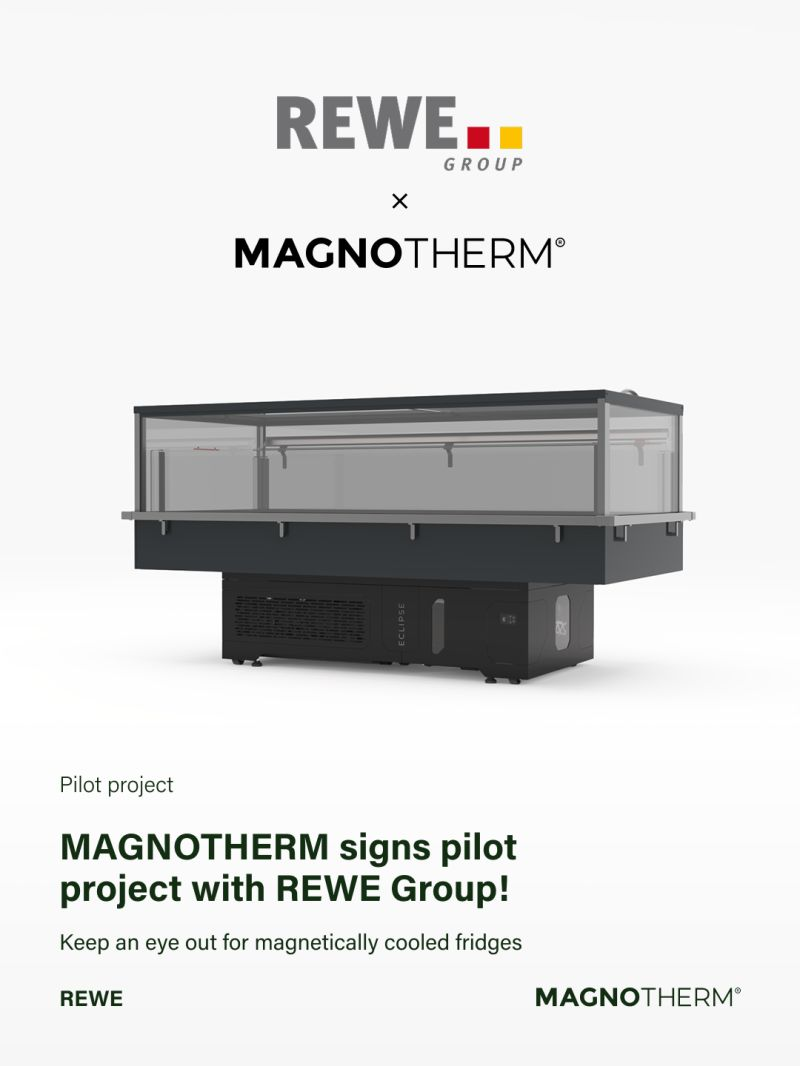
Two prototype magnetocaloric refrigeration units
Why is this exciting?
Compared with conventional systems, magnetocaloric devices:
- Use solid magnetic refrigerants instead of gaseous refrigerants, avoiding the need for conventional refrigerant gases such as high-GWP HFCs and newer low-GWP HFOs.
- Eliminate compressors and complex gas-compression cycles.
- Offer the potential for higher energy efficiency, lower noise, and reduced environmental impact.
- Offer a high level of safety due to the absence of hazardous coolants.
- Require significantly less maintenance because of low operating pressure and a confined system architecture.
Because of these advantages, magnetocaloric technology is increasingly considered a promising advanced alternative for future cooling and heating systems.
2. How Magnetocaloric Cooling Works?
The magnetocaloric effect arises from changes in magnetic entropy—the degree of disorder of the magnetic moments within the material. When a magnetic field is applied, magnetic moments align, releasing heat; when the field is removed, the moments become disordered and absorb heat from the surroundings [13].
The effect is captured by two key quantities:
- Magnetic entropy change (ΔSM): Represents the amount of heat that can be pumped in one refrigeration cycle.
- Adiabatic temperature change (ΔTad): Represents the achievable temperature change per cycle and is the driving force for heat exchange.
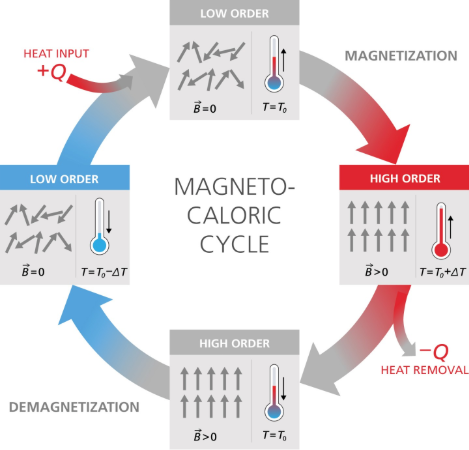
To produce extended temperature span and elevated cooling power, devices use an Active Magnetic Regenerator (AMR) cycle, where magnetocaloric materials are arranged as porous beds or plates while a fluid flows through to transfer heat [14,3]. The cycle consists of four steps: magnetization, heat rejection, demagnetization, and heat absorption.
Each material operates most effectively near its Curie temperature—the temperature at which it transitions between magnetic and non-magnetic behaviour. By stacking materials with slightly different Curie temperatures, the system can operate efficiently across a wider temperature range and achieve the temperature spans required for refrigeration or heat pumping.
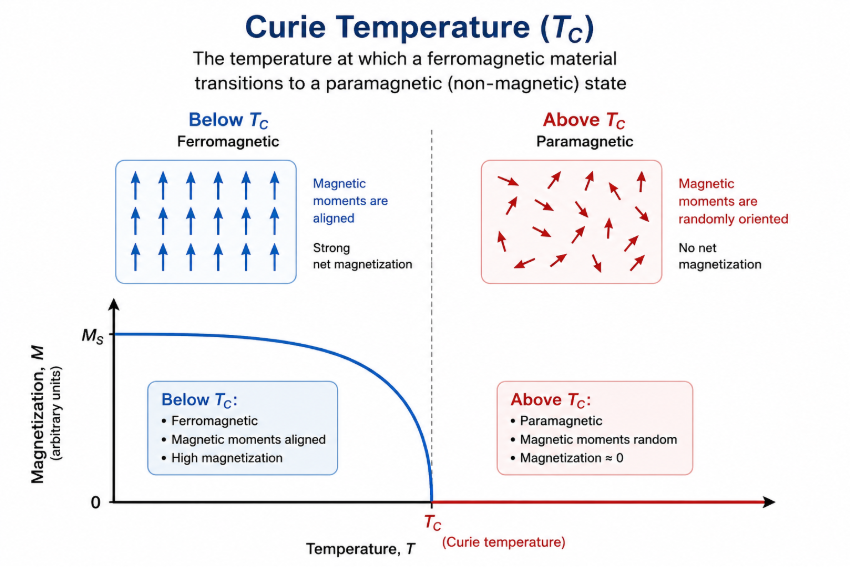
3.What’s It Made Of?
Key materials
Magnetocaloric cooling uses solid magnetic materials instead of greenhouse gas refrigerants. Choosing the right material is where things get complicated, and where the most interesting engineering battles are being fought.
Gadolinium (Gd) and its alloys (GdSiGe, GdEr) were the original stars of the field. They offer excellent magnetocaloric performance — but Gadolinium is costly, depends on rare-earth supply chains, and exhibits a broad but flat magnetic transition that can limit efficiency under some operating conditions. Moreover, the Gd alloys are generally limited in low-to-room temperature application due to the constrain on transition temperatures. Despite strong performance, its high cost and rare-earth dependence make it economically unattractive for large-scale deployment. All these factors have restricted commercialization.
La–Fe–Si (used by companies such as Vacuumschmelze [15]) achieves high magnetocaloric performance and contains less rare-earth content than Gadolinium — but it still contains Lanthanum, so it’s not truly rare-earth-free. It’s also brittle and chemically reactive, making it prone to cracking and corrosion unless protected, which adds complexity in processing and long-term durability. It offers a partial cost improvement over Gadolinium, but complicated production process and cyclic stability concern still limits its long-term economic scalability. In addition, La(Fe,Si)₁₃ materials often require chemical substitution or hydrogen insertion to tune the operating range, which can add processing complexity and raise mechanical durability concerns during repeated operation [16,17].
Mn–Fe–P–Si (developed by Magneto B.V. and TU Delft) is among the more promising non-rare-earth magnetocaloric material systems currently under development. It is considered one of the more commercially promising non-rare-earth magnetocaloric materials, made from earth-abundant, relatively environmentally benign elements and offering mechanical robustness that may support scalable manufacturing [5]. Its operating temperature can also be tuned for different applications. Its main drawback is hysteresis: energy losses as the material cycles through magnetization. But these losses can be reduced through smarter material design and optimized system operation. Of the three, Mn–Fe–P–Si offers the best mechanical stability and is easiest to shape into practical cooling components. Its rare-earth-free composition gives it a clear cost advantage and avoids supply-chain dependency concerns, making it the most economically scalable option among current magnetocaloric materials. This division of roles is important in the emerging magnetocaloric ecosystem: Magneto’s material platform addresses one of the core bottlenecks for scalable magnetocaloric cooling, while system developers such as Magnoric and Magnotherm focus on complete cooling units and architectures built around magnetocaloric materials [5,7,8].
The advantage of Mn–Fe–P–Si is not just that it performs well in the lab. More importantly, it is better suited for real machines that run cycle after cycle. Its operating temperature can be adjusted for different cooling and heat-pump needs, and it performs well under the lower magnetic fields expected in commercial systems. This makes it more practical for real-world products [18,19].
| Material | Performance | Cost | Mechanical Properties | Limitation | Commercial Potential |
| Gadolinium (Gd) | Moderate to strong MCE, but broad magnetic transition → lower peak efficiency | High cost, rare-earth dependent | Good | Broad transition, expensive | Limited |
| La–Fe–Si | Strong MCE with relatively sharp transition → better peak performance | Medium, still rare-earth (La) | Brittle, corrosion risk | Processing complexity, hydrogenation/tuning and cycling durability concerns | Moderate |
| Mn–Fe–P–Si | Strong MCE with tuneable transition → wide Curie temperature range and efficient across applications | Low cost, abundant elements | Robust, easy to shape; promising for repeated cycling | Hysteresis losses (reducible), process sensitive properties | High |
Among current materials, Mn–Fe–P–Si offers the best balance of performance, cost, and scalability, making it the most promising candidate for real-world applications. In short, the likely winning material is not simply the one with the highest lab peak, but the one that can be trusted in real heat-pump hardware.
4. Is It Actually More Efficient?
This is the question everyone asks, and the answer is: yes, it depends.
Efficiency in magnetocaloric systems is measured using the Coefficient of Performance (COP)—the ratio of useful heating or cooling output to the input work required to operate the system [20]. Importantly, COP is a system-level metric, meaning it depends not only on the material itself but also on how the system is designed and operated. As a result, COP can vary significantly depending on factors such as system architecture, temperature range, heat exchange efficiency, and operating conditions.
Magnetocaloric heat pumps can theoretically achieve around 30% higher thermodynamic efficiency than conventional vapor-compression systems due to reduced mechanical losses [20,21,22]. Early studies and prototypes suggest that magnetocaloric systems have the potential to outperform traditional cooling technologies in energy efficiency, although real-world performance depends strongly on system design and operating conditions [3].
5. Why Is Magnetocaloric Cooling Better Than Conventional Refrigeration?
Magnetocaloric systems provide several environmental and operational benefits compared to conventional vapor‑compression refrigeration:
- No greenhouse gases.
Because they replace refrigerant gases with solid magnetic materials, magnetocaloric systems completely avoid greenhouse‑gas emissions from leaks or disposal, a major environmental concern in traditional systems [23].
- Quieter
With no compressors and only modest fluid pumps, magnetocaloric devices operate with significantly lower noise levels and vibration. This not only improves user comfort but also reduces mechanical wear, contributing to potentially longer lifetimes and lower maintenance needs [24].
- Higher efficiency:
Solid‑state magnetic refrigeration processes are more reversible and avoid energy losses inherent to gas‑compression cycles. This can translate into up to 30% higher efficiency under certain designs, resulting in reduced electricity use and lower indirect carbon emissions over the device lifetime — with examples from Gree, Haier, and NanoGEIOS Laboratory [21,22].
- More sustainable
Without complex gas handling or high‑pressure compressor systems, manufacturing can be simpler and associated environmental impacts reduced. Additionally, the operational longevity and reduced replacement rates further lower the environmental footprint over time [25].
- Less maintenance
Fewer moving parts may reduce wear. No complex gas-handling infrastructure. This could support simpler manufacturing, lower maintenance, and longer device lifetime [24,26].
- Safer, and more reliable
Unlike conventional systems that rely on high-pressure refrigerants (such as CO₂ systems) and mechanical compressors, magnetocaloric systems operate at low pressure and use solid materials. This reduces the risk of leaks, high-pressure failures, and hazardous refrigerants. With fewer moving parts, these systems can also achieve higher reliability and lower maintenance requirements [27].
These combined advantages make magnetocaloric refrigeration an attractive next‑generation sustainable cooling and heating technology with potential benefits for both residential and industrial applications.
Conclusion: Towards a Magnetic Future
Magnetocaloric refrigeration represents a transformative approach to sustainable cooling and heating. With solid-state magnetic materials such as Mn–Fe–P–Si and La–Fe–Si, these systems overcome many limitations of Gadolinium and conventional gas-based systems. Mn–Fe–P–Si stands out for scalability, cost-effectiveness, and robustness, while La–Fe–Si provides high performance with more complex handling requirements. More importantly, Mn–Fe–P–Si is not only promising in the lab, but also appears buildable for practical heat-pump systems because it combines strong material performance with adjustable operating temperatures, repeated-cycle stability, and low-field operation. As research and industrial prototypes advance, magnetocaloric devices are poised to deliver cooling and heating solutions that are quieter, greener, more energy-efficient, safer, lower-maintenance, and free from conventional refrigerant-gas leakage risks.
References
[1] Kitanovski, A. (2020). Energy applications of magnetocaloric materials. Advanced Energy Materials, 10(10), 1903741. https://doi.org/10.1002/aenm.201903741
[2] Gschneidner, K. A., Pecharsky, V. K., & Tsokol, A. O. (2005). Recent developments in magnetocaloric materials. Reports on Progress in Physics, 68(6), 1479–1539. https://doi.org/10.1088/0034-4885/68/6/r04
[3] Kitanovski, A., Tušek, J., Tomc, U., Plaznik, U., Ožbolt, M., & Poredoš, A. (2014). Magnetocaloric Energy Conversion: From Theory to Applications. https://doi.org/10.1007/978-3-319-08741-2
[4] Griffith, L. D., Mudryk, Y., Slaughter, J., & Pecharsky, V. K. (2018). Material-based figure of merit for caloric materials. Journal of Applied Physics, 123(3). https://www.osti.gov/pages/servlets/purl/1417991
[5] Magneto B.V. (2024). Technology. https://magneto.systems/magneto-technology/
[6] Polo UFSC. (2026). POLO – Research Laboratories in Refrigeration and Thermophysics. https://polo.ufsc.br/en/
[7] Magnoric. (2026). Pioneers of magnetic cooling. https://magnoric.com/
[8] Magnotherm. (2026). Magnetic cooling technology. https://www.magnotherm.com/
[9] Baotou Research Institute of Rare Earths. (2022). Profile. https://en.brire.com/article/content-9.html
[10] Fraunhofer IFAM. (2025). Magnetocaloric technology supports energy efficiency. https://www.ifam.fraunhofer.de/en/technologies/magnetocaloric-technology-supports-energy-efficiency.html
[11] Barbosa Jr., J., Lozano, J., & Trevizoli, P. (2014). Magnetocaloric refrigeration research at the INCT in Cooling and Thermophysics. Proceedings of the 15th Brazilian Congress of Thermal Sciences and Engineering.
[12] Bam. (2026). https://www.bam.de/Navigation/DE/Home/home.html
[13] Pecharsky, V. K., & Gschneidner, K. A. (1999). Magnetocaloric effect and magnetic refrigeration. Journal of Magnetism and Magnetic Materials, 200(1–3), 44–56. https://doi.org/10.1016/S0304-8853(99)00397-2
[14] Barclay, J. A., & Steyert, W. A. (1982). Active magnetic regenerator. U.S. Patent. https://patentimages.storage.googleapis.com/6a/12/44/22460fdd3f9faf/US4332135.pdf
[15] VAC – Vacuumschmelze. (2025). Advanced magnetic solutions. https://vacuumschmelze.com
[16] Paul-Boncour, V., & Bessais, L. (2021). Tuning the magnetocaloric properties of the La(Fe,Si)₁₃ compounds by chemical substitution and light element insertion. Magnetochemistry, 7, 13. https://www.mdpi.com/2312-7481/7/1/13
[17] Kaeswurm, B., et al. (2017). Behaviour of the Young’s modulus at the magnetocaloric transition in La(Fe,Co,Si)₁₃. Journal of Alloys and Compounds, 697, 427–433. https://www.sciencedirect.com/science/article/abs/pii/S0925838816338439
[18] Brück, E., Yibole, H., & Zhang, L. (2016). A universal metric for ferroic energy materials. Philosophical Transactions of the Royal Society A, 374, 20150303. https://doi.org/10.1098/rsta.2015.0303
[19] You, X., et al. (2022). “Magnetic Phase Diagram of the MnxFe2−xP1−ySiy System.” Entropy, 24(2). https://www.mdpi.com/1099-4300/24/1/2
[20] Brown, G. V. (1976). Magnetic heat pumping near room temperature. Journal of Applied Physics, 47(8), 3673–3680. https://nanophys.ru/data/documents/1976_Brown_Magnetic-heat-pumping.pdf
[21] PatSnap Eureka. (2025). Integration of magnetocaloric cooling with building HVAC controls. https://eureka.patsnap.com/report-integration-of-magnetocaloric-cooling-with-building-hvac-controls
[22] Market Growth Reports. (2025). Magnetic refrigeration system market size, share, growth, and industry analysis, by type (refrigeration systems, air conditioning systems, heat pumps), by application (home use, commercial, transportation, industrial), regional insights and forecast to 2035 (Report No. MGR100254). https://www.marketgrowthreports.com/market-reports/magnetic-refrigeration-system-market-100254
[23] McNerney, G. W. (2025). The environmental impact and energy efficiency of magnetocaloric refrigeration systems. International Journal of Environmental Sustainability and Green Technologies, 15(1), 1–13. https://www.igi-global.com/gateway/article/full-text-html/369160
[24] Alahmer, A., Al-Amayreh, M., Mostafa, A. O., Al-Dabbas, M., & Rezk, H. (2021). Magnetic Refrigeration Design Technologies: State of the Art and General Perspectives. Energies, 14(15), 4662. https://pdfs.semanticscholar.org/ccc5/1fac39cba596720c7f9e1eecb650a696054b.pdf
[25] Monfared, B., Furberg, R., & Palm, B. (2014). Magnetic vs. vapor-compression household refrigerators: A preliminary comparative life cycle assessment. International Journal of Refrigeration, 42, 69–76. https://kth.diva-portal.org/smash/get/diva2:730820/FULLTEXT01
[26] Dorin, B., Plesca, A., & Avsec, J. (2018). The Efficiency Of Magnetic Refrigeration And A Comparison With Compressor Refrigeration Systems. Journal Of Energy Technology, 11(3), 59–69. https://journals.um.si/index.php/jet/article/view/3693/2592
[27] Greco, A., Farina, A. R., & Masselli, C. (2021). Caloric Solid-State Magnetocaloric Cooling: Physical Phenomenon, Thermodynamic Cycles and Materials. Tecnica Italiana-Italian Journal Of Engineering Science, 65(1), 58–66. https://doi.org/10.18280/ti-ijes.650109


