
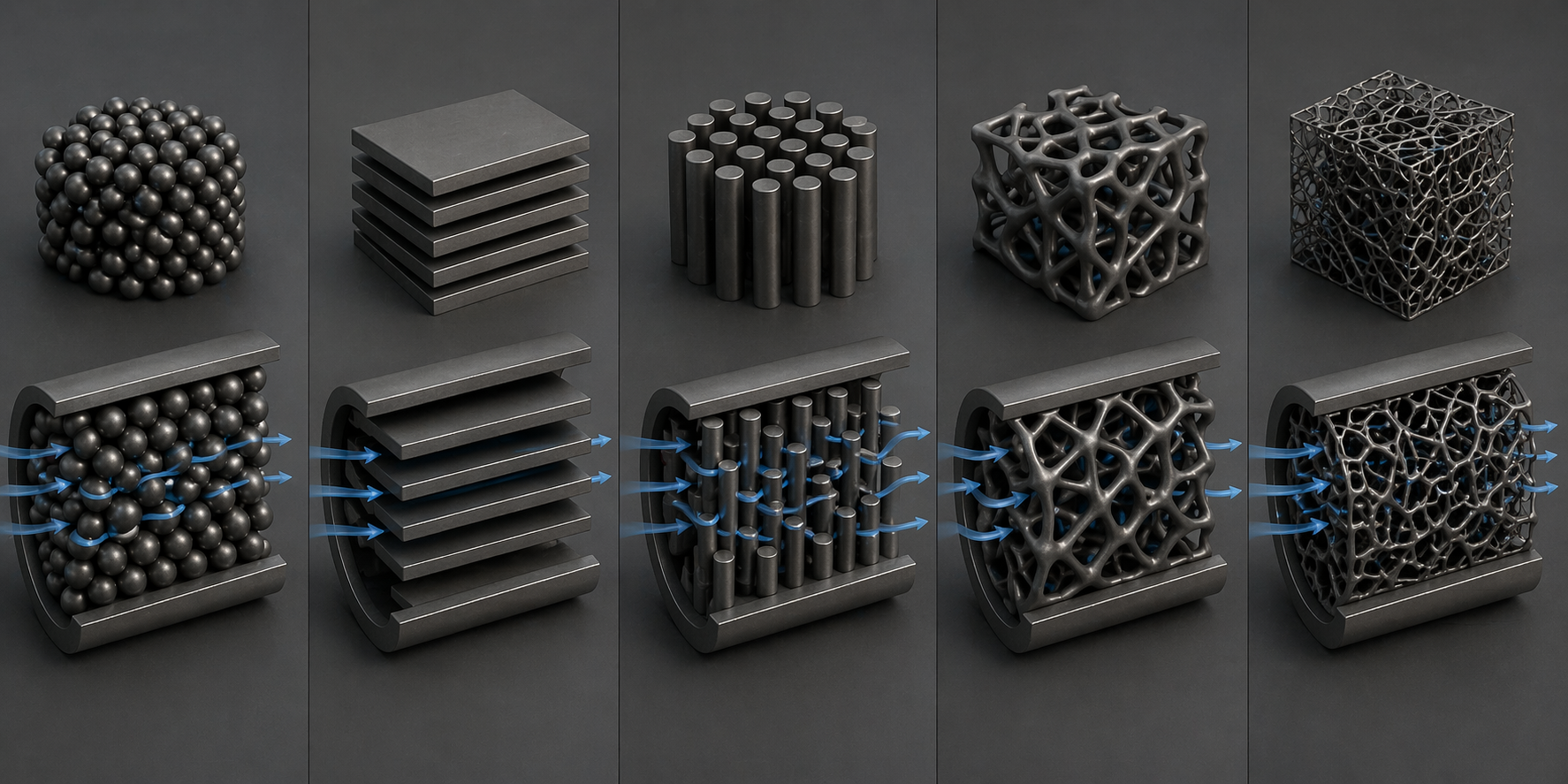
Magnetocaloric coolers depend on two things working well together: the material, and the heat exchange structure they are built into. As a result, the right geometry can make a measurable difference in how much performance they actually show in practice.
The Hidden Bottleneck: The Regenerator
The component doing the heavy lifting inside a magnetocaloric system is called an Active Magnetic Regenerator (AMR). As fluid flows through it, it picks up and deposits heat while magnetocaloric material cycles in and out of a magnetic field. The geometry of that structure — how the material is shaped, how fluid moves through it — determines heat transfer efficiency, pumping energy cost, and mechanical durability all at once.
For this reason, researchers have spent years testing different AMR geometries. Each one involves a genuine trade-off.
Four Trade-offs, One Sweet Spot
Packed sphere beds:
Imagine filling a tube with tiny magnetocaloric balls and pumping fluid through the gaps between them. There’s a lot of surface contact, which is great for heat transfer. However, all those balls packed together create a maze for the fluid — it takes significant pump energy just to push it through, which chips away at the efficiency you were trying to gain [1, 2].
Parallel plates
At the other extreme, picture a stack of flat slabs with thin fluid channels running between them — like a waffle iron. Although fluid flows through easily, the channels are so uniform and smooth that heat exchange turns out to be underwhelming in practice. Moreover, the thin sections are fragile, and tiny manufacturing imperfections have an outsized effect on performance [1, 2].
Pin arrays, screens, and wire bundles
These look a bit like a bed of nails or a fine mesh — better heat transfer than flat plates, less resistance than packed balls. However, the catch is manufacturing: shaping brittle magnetocaloric materials into precise pins or wires without cracking them is genuinely difficult with conventional production methods.
Structured microchannels and lattices
By comparison, think of an open 3D scaffold — like a sponge with a very regular, engineered structure. Fluid flows through cleanly, heat transfer is strong, and because it’s all one solid piece, nothing rattles loose or migrates over time [3, 4]. However, the challenge has always been making these structures accurately enough, in a real magnetocaloric material at scale.
3D printed mesh
Magneto’s 3D printed mesh falls into this last class. The geometry is shaped with magnetic field direction in mind — structures that ignore field orientation can suffer demagnetization losses that quietly erode the benefits of a high-surface-area design [4, 11]. In addition, the mesh is printed as a single monolithic piece with fiber thickness below 250 microns [14], which sits in the submillimeter range that both modeling and experiments identify as the sweet spot for combining heat transfer quality with manageable pressure drop [3, 4]. In practice, individual exchangers are stacked in a cascade, each delivering 1-2 °C of temperature lift, making the overall system modular rather than fixed [11]. Nevertheless, the only open question is independent module benchmarking under long-duration cycling.
AMR Geometry Comparison
| Architecture | Heat transfer | Flow resistance | Structural durability |
| Packed sphere beds | ✓✓ High | ✗✗ Very high | ✗ Particle damage risk |
| Parallel plates | ✗ Low in practice | ✓✓ Low | ✗ Fragile thin sections |
| Pin arrays / screens | ✓ Moderate | ✓ Moderate | – Hard to shape brittle materials |
| Structured lattices / microchannels | ✓✓ High | ✓ Low–moderate | ✓ Monolith, no loose parts |
| Magneto 3D mesh [11, 14] | ✓✓ High | ✓ Low–moderate | ✓✓ Monolith; field-aware geometry |
Overall, the first four geometries each involve a genuine compromise: high heat transfer usually comes with high flow resistance, while low resistance often comes at the cost of heat transfer quality. Therefore, this is where the 3D mesh stands out. It combines the heat transfer density of packed beds with the low flow resistance of parallel plates, while adding the structural stability of a single monolithic design.
The Material Side of the Story
A well-designed geometry only works if the material inside it can support long-term cyclic operation. Magneto builds on the Mn-Fe-P-Si family, developed at TU Delft, which the materials literature identifies as one of the strongest candidates for room-temperature magnetic refrigeration [5].
The comparison with alternatives is instructive. Gadolinium — the standard laboratory benchmark — is well understood but rare-earth-dependent, expensive, and prone to corrosion [7]. La-Fe-Si hydrides can deliver impressive magnetocaloric effects near room temperature but are brittle, difficult to shape, and have documented corrosion and fluid stability problems [8, 9]. Heusler alloys cover a broad composition space but typically carry large hysteresis losses that reduce their practical output under repeated cycling [10].
In contrast, Mn-Fe-P-Si avoids the rare-earth supply issue and has a transition temperature that can be tuned compositionally. Magneto has reported Mn-Fe-P-Si material compositions covering −20 °C to +50 °C [14].In addition, the material benefits from doping strategies, including Co-B and Ni-B additions, that reduce hysteresis while preserving a large magnetocaloric effect and improving mechanical stability [6, 10]. That tunability is particularly relevant for a cascade architecture, where each stage ideally operates at a slightly different working temperature.
The known weakness of this material family is corrosion and fracture risk under cycling. Magneto addresses this directly with a dedicated water-based protective fluid [11, 12] — a design decision that reflects the actual failure modes of first-order magnetocaloric materials rather than treating fluid compatibility as an afterthought.
Putting It Together
The AMR design challenge is not about optimizing one variable. It is about finding a geometry that is thermally efficient, hydraulically reasonable, mechanically durable, manufacturable in a functional material, and stackable into a real product. Most magnetocaloric platforms struggle at one or more of those steps.
Magneto has reported stable production of sub-250-micron printed exchangers, a temperature-targeted material library, and a complete assembled product — including the fluid and integration support — rather than material supply alone [12, 14]. However, independent module benchmarking under long-duration cycling is still the open question. But on the engineering design choices alone, the approach sits in the part of the space that current AMR research consistently regards as the most viable route forward [3, 5, 14].
References
[1] Tušek et al. Int. J. Refrigeration 36 (2013) 1456–1464. DOI: 10.1016/j.ijrefrig.2013.04.001
[2] Trevizoli et al. Applied Energy 187 (2017) 847–861. DOI: 10.1016/j.apenergy.2016.11.031
[3] Trevizoli et al. Applied Thermal Engineering 160 (2019) 113990. DOI: 10.1016/j.applthermaleng.2019.113990
[4] Liang et al. Applied Thermal Engineering 186 (2021) 116519. DOI: 10.1016/j.applthermaleng.2020.116519
[5] Miao et al. Rare Metals 37 (2018) 723–733. DOI: 10.1007/s12598-018-1090-2
[6] Thang et al. Materials 10 (2017) 14. DOI: 10.3390/ma10010014
[7] Mellari. Int. J. Air Conditioning and Refrigeration (2023). DOI: 10.1007/s44189-023-00021-z
[8] Paul Boncour & Bessais. Magnetochemistry 7 (2021) 13. DOI: 10.3390/magnetochemistry7010013
[9] Guo et al. Chemical Communications 55 (2019) 3642–3645. DOI: 10.1039/C9CC00640K
[10] Gutfleisch et al. Phil. Trans. Royal Society A 374 (2016) 20150308. DOI: 10.1098/rsta.2015.0308
[11] Magneto. Technology page. Accessed 23 March 2026.
[12] Magneto. Products page. Accessed 23 March 2026.
[14] European Commission CORDIS. EIC project reporting for Magneto. Accessed 23 March 2026.


